Protein per meal: does spreading it out matter?
Eating protein evenly across the day raised muscle-building by a quarter over 24 hours. The two trials that ran for weeks and weighed the muscle found no significant difference. Total intake matters most.
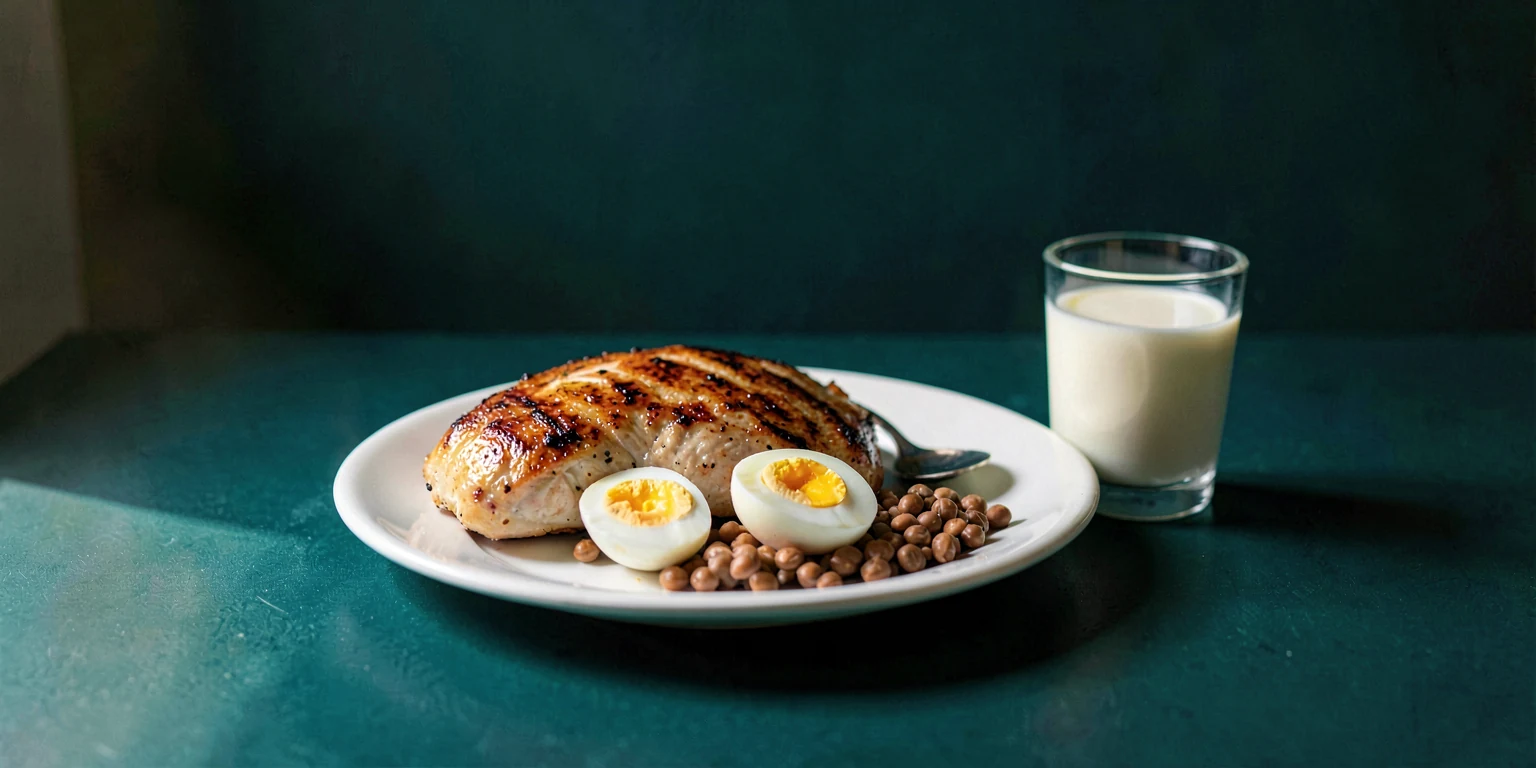
Spread the same protein evenly across three meals instead of loading it into dinner, and muscle builds new protein about 25% faster over the day.1 Then the two trials that ran for weeks and actually weighed the muscle found no significant difference.5,6 The daily total matters most. The arrangement looks like a detail.
Where the rule of thumb came from
Muscle protein synthesis — the rate at which muscle assembles new protein — rises with the size of a meal up to a point, then flattens. Amino acids past that point are mostly burned for energy instead of built in. That is the observation behind the idea that a large protein meal wastes some of itself.2
The trial everyone cites gave 24 trained men 80 g of whey over the 12 hours after a lifting session, in one of three patterns.3 Some drank 10 g every 1.5 hours. Some drank 20 g every 3 hours. Some drank 40 g every 6 hours. All three patterns lifted synthesis well above resting, by 88% to 148%.3 The middle pattern won, beating the other two by 31% to 48%.3
That is where "20 grams every three hours" comes from.3 It is worth being exact about what was measured. A chemical signal, over half a day, in trained men, drinking whey after exercise. No muscle was weighed and no ordinary meals were served.
The study behind the even-spread advice
Eight healthy adults ate two diets, matched for calories and for protein, for seven days each, with a month between them.1 One diet split the protein almost evenly: 31.5 g at breakfast, 29.9 g at lunch, 32.7 g at dinner. The other skewed it the way most people actually eat: 10.7 g, 16.0 g, then 63.4 g at dinner.1
Measured across a full 24 hours, synthesis ran 25% higher on the even diet, 0.075% of muscle per hour against 0.056%.1 The gap was still there after a week on each pattern.1
A larger study found nothing of the kind
Forty active adults, 28 men and 12 women, ate either an omnivorous or a vegan diet through nine days of resistance training.4 Everyone got 1.1 to 1.2 g of protein per kilogram a day, which is 77 to 84 g for a 70 kg adult. Within each diet, protein was either lopsided — 10%, 30% and 60% of the day's protein across three meals — or balanced at 20% across five eating occasions.4 Daily synthesis landed between 2.43% and 3.04% per day, with no difference among the four groups.4
Two studies, two answers. The first tracked single days under a continuous tracer. The second averaged nine days in which training was also driving the response, which may simply be a stronger signal than mealtimes.4 Neither one weighed any muscle.
What happened when someone did weigh the muscle
Two training trials moved protein around the day while holding the daily total fixed.
In the first, 26 young men lifted three times a week for 12 weeks on 1.30 g of protein per kilogram a day — about 91 g for a 70 kg man.5 One group front-loaded it, taking 0.33 g per kilogram at breakfast and 0.48 g at dinner. The other took 0.12 g at breakfast and 0.83 g at dinner, which at 70 kg is roughly 8 g of protein in the morning against 23 g.5
Both groups gained. The breakfast group added 2.5 kg of lean mass and the dinner group 1.8 kg.5 That gap missed statistical significance, at P = 0.06, while the effect size was 0.795 — large by the usual reading, where 0.2 counts as small, 0.5 as moderate and 0.8 as large.5 A large difference that 26 men cannot separate from chance is the signature of a study too small for its question.
The second trial split the same protein across either three or five meals, each carrying at least 0.24 g per kilogram — around 17 g for a 70 kg man.6 Thirty-two trained young men started eight weeks of lifting; only 18 finished.6 Lean mass rose 1.15 kg on three meals and 0.63 kg on five, and knee-extension strength 19.08 kg against 16.01 kg, with no significant difference either way.6
Neither trial is large and both enrolled young men who train. Together they found no significant difference, though both were too small to rule out a modest one.5,6

Why the total keeps swallowing the effect
A review of this literature reached the conclusion the trials keep illustrating: distribution cannot be separated from quantity.2 Change how protein is spread and you almost always change how much there is.
The reason is breakfast. Breakfast is where protein goes missing, so advice to fix the spread is usually advice to add protein — and the daily total goes up with it.2 The review found the clearest use for balanced eating in adults taking in less than 0.80 g per kilogram a day, about 56 g at 70 kg, for whom a better spread is a practical route to a higher total.2 For people already between 0.8 and 1.3 g per kilogram, the conclusion was different: what supports muscle is having at least one meal with enough protein to drive synthesis fully, no matter how the rest of the day falls.2
Distribution is a second-order variable
It only has room to act once two other things are in place: enough protein overall, and something asking the muscle to grow.
Feeding trials in older adults averaging about 1.3 g per kilogram a day — 91 g at 70 kg — did not move lean body mass or physical function on their own.7 The same intakes did move lean mass when paired with resistance training or with weight loss.7 Without one of those, there is nothing for a rearranged schedule to improve on.
What remains unknown
The trials that could settle this were small, short and mostly in young men: eight, 26, 32 and 40 people, over seven days to 12 weeks.1,5,6,4 One of them lost 14 of its 32 volunteers before the end.6
Nobody has followed older adults — the group with the most muscle to lose — through a change in distribution at a matched daily intake over months. Whether the acute advantage of an even split ever accumulates into visible muscle is the open question. The 12-week trial that came closest found 2.5 kg against 1.8 kg, which sits exactly at the edge of what 26 people can resolve.5
QUESTIONS THIS POST ANSWERS
- Is there a limit to how much protein the body can use from one meal?
- For the muscle-building response, yes. Muscle protein synthesis rises with the dose up to a saturating point, and amino acids beyond it are mostly oxidized. In trained men, 20 g of whey every 3 hours after lifting stimulated more synthesis over 12 hours than either 10 g every 1.5 hours or 40 g every 6 hours.
- Does eating protein at breakfast make a difference?
- At the margin, it may. In a 12-week training trial in young men, moving protein from dinner to breakfast produced a lean mass gain of 2.5 kg against 1.8 kg, a difference that did not reach statistical significance. A review of this literature found that adding protein at breakfast usually raises the daily total too, and the two effects are hard to separate.
REFERENCES
Each reference was re-checked against PubMed before publication. How sources are checked
- 1Mamerow MM, et al. Dietary protein distribution positively influences 24-h muscle protein synthesis in healthy adults. The Journal of nutrition. 2014. Source
- 2Hudson JL, et al. Protein Distribution and Muscle-Related Outcomes: Does the Evidence Support the Concept? Nutrients. 2020. Source
- 3Areta JL, et al. Timing and distribution of protein ingestion during prolonged recovery from resistance exercise alters myofibrillar protein synthesis. The Journal of physiology. 2013. Source
- 4Askow AT, et al. Impact of Vegan Diets on Resistance Exercise-Mediated Myofibrillar Protein Synthesis in Healthy Young Males and Females: A Randomized Controlled Trial. Medicine and science in sports and exercise. 2025. Source
- 5Yasuda J, et al. Evenly Distributed Protein Intake over 3 Meals Augments Resistance Exercise-Induced Muscle Hypertrophy in Healthy Young Men. The Journal of nutrition. 2020. Source
- 6Tavares H, et al. Effects of daily protein intake frequency during 8 weeks of resistance training on lean mass and strength adaptations: a randomized non-controlled clinical trial. The Journal of sports medicine and physical fitness. 2025. Source
- 7Campbell WW, et al. Nutritional Interventions: Dietary Protein Needs and Influences on Skeletal Muscle of Older Adults. The journals of gerontology. Series A, Biological sciences and medical sciences. 2023. Source