Protein and fullness: why higher-protein diets tend to work
Trade carbohydrate for protein at the same calories and you lose about 0.79 kg more in twelve weeks. Protein really does make people feel fuller. Its sturdier benefit is keeping weight off.
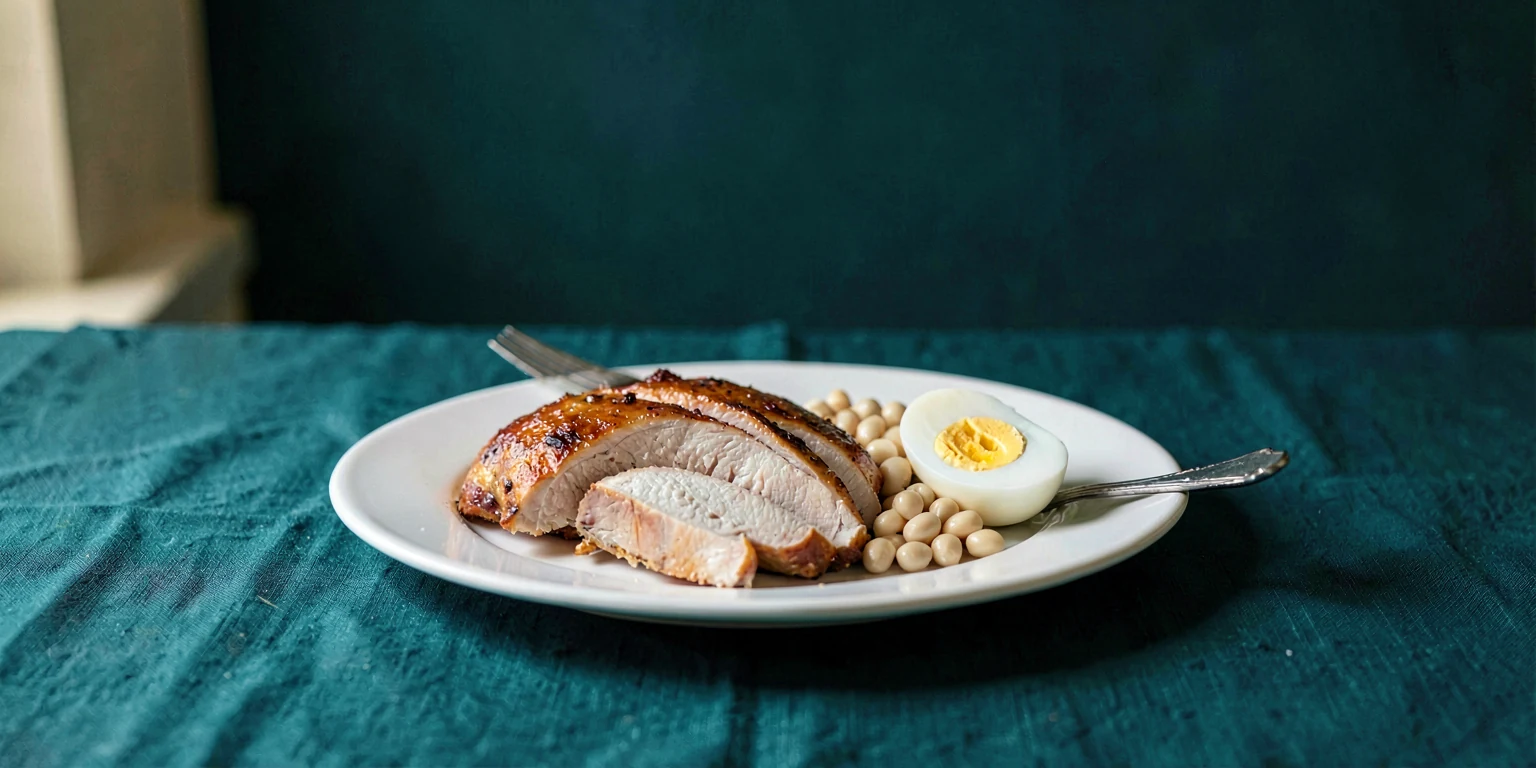
Eating more protein and less carbohydrate, with calories held the same, is worth about 0.79 kg of extra weight loss over twelve weeks.1 That is a small return. The bigger one arrives later. Protein has the best record of any diet strategy for keeping lost weight off.3
The trials that held calories still
The cleanest evidence comes from trials that refused to let calories vary. Both groups ate the same number of calories. Both ate the same amount of fat. The only thing that changed was how much of the rest arrived as protein rather than as carbohydrate. Twenty-four such trials, covering 1,063 adults over an average of 12.1 weeks, have been added together.1
That design answers one narrow question well. It asks what the swap does on its own, with appetite taken out of the picture, because the food was prescribed either way.
It also means the result is not quite what most people want to know. Nobody hands you a fixed calorie budget in daily life. The question at home is whether more protein makes the budget easier to keep, and these trials were built so that they could not answer it.
What the swap bought
More weight lost, and more of it from fat. The higher-protein groups lost 0.79 kg more, and 0.87 kg more of that loss was fat.1 The weight figure comes with a wide margin: the true difference sits somewhere between 1.50 kg and a hair above nothing.1
Two other results are easier to miss and more interesting. The higher-protein groups kept 0.43 kg more lean tissue — muscle and organ, the part of body weight you would rather not lose.1 And their metabolism slowed less. Cutting calories always drags resting energy use down. On the higher-protein diets it fell by 595.5 kJ a day less, which is roughly 140 food calories.1
Triglycerides fell further too, by 0.23 mmol/L. Glucose, insulin, blood pressure and both kinds of cholesterol moved alike on both diets.1
So the scale understates it. Read the weight number alone and the advantage is slight. Read the body composition and the same trials look better: at identical calories, more of what left was fat and less of it was muscle.1
Protein does make people feel fuller
Two mechanisms are well established. The first is thermogenesis: the body spends energy digesting and processing what it eats, and protein costs more to process than carbohydrate or fat. The second is satiety, the feeling of having had enough. A review of the controlled studies called the evidence for both convincing, and judged that higher-protein meals do reduce how much people eat next.2 That same review found the evidence for weight and fat loss less consistent than the evidence for fullness.2
Only five of the matched-calorie trials asked people how full they felt. Three of those five found the higher-protein group fuller.1
Where fullness stops turning into eating less
Feeling full and eating less are two different measurements, and they do not always agree.
One trial gave 24 healthy adults a whey drink containing 25 g of protein, about a scoop of powder, on two separate occasions.7 On one of them an enzyme was added to speed the protein's digestion. Ghrelin, the hormone that climbs when you are hungry, ran 12% lower on the enzyme day, and the volunteers rated themselves fuller.7 Then they were offered a buffet. They ate the same amount either way.7
That is the honest state of the mechanism. Fullness is real and it is measurable. Whether it carries through to a smaller next meal gets measured far less often than it gets assumed.
Regain is where protein holds up best
The most consistent finding here is not about losing weight. It is about not putting it back.
One review compared maintenance strategies across 21 studies in 2,875 adults, twelve of which tested extra protein.3 Protein was the only strategy that worked. Lower glycemic index, green tea, conjugated linoleic acid and more fiber were all tested alongside it, and none of them reached significance.3
Its size was -0.17 on a standardized scale. On that scale 0.2 counts as a small effect, 0.5 as moderate and 0.8 as large. So this is a real benefit sitting just below small — and, unusually, one the individual studies agreed on.3
A second review took the hardest case. These were people who had just finished a very-low-calorie diet and lost 12.3 kg.4 Over a median of five months, higher-protein eating held on to 1.5 kg more than the comparison approach.4 Meal replacements did better, at 3.9 kg. Exercise managed 0.8 kg and missed significance, and supplements returned exactly 0.0 kg.4 A kilo and a half is not dramatic. It beat almost everything else on offer.
Where the advantage runs out
Time takes it. Across 121 trials in 21,942 adults comparing 14 popular diets, weight loss had shrunk by twelve months whatever the diet was made of, and the heart-risk benefits of every one except the Mediterranean diet had essentially vanished.5 At six months, low-carbohydrate and low-fat diets had produced nearly identical losses, 4.63 kg against 4.37 kg.5 What a diet is made of predicts less than whether people stay on it.
Who is eating matters too. In eight trials of 300 women with polycystic ovary syndrome, higher-protein diets produced the same weight loss, waist change and blood fats as balanced diets at the same calories.6 What moved instead was fasting insulin, down 2.69 μIU/mL.6 Insulin resistance improved as well, but those studies disagreed with each other so badly — 94% of the spread in their results was genuine disagreement rather than chance — that the number should not be leaned on.6
What remains unknown
The step everyone assumes has never been isolated. The matched-calorie trials show a small advantage. The reviews show protein raises fullness. Nothing here shows that eating more protein lowers what people eat by enough to account for the weight difference.1,2 Fullness was rated in five of those 24 trials, and what people ate afterwards in fewer still.1
Which protein foods do the most is not answered anywhere in this evidence, because these were comparisons of diets rather than of foods. And the maintenance result rests on a median of five months of follow-up.4 Weight is regained over years.
QUESTIONS THIS POST ANSWERS
- Does protein help with weight loss even without cutting calories?
- None of the trials pooled here tested extra protein on top of an unrestricted diet. The cleanest comparisons prescribed the same calories and the same fat to both groups and varied only protein and carbohydrate, and the advantage was 0.79 kg over about twelve weeks. Protein's measured effects on fullness and on thermogenesis are the reason it may lower calories on its own, but that step has not been isolated in these trials.
- Which protein foods are the most filling per calorie?
- These trials compared diets, not foods, so the question has no answer in this evidence. Greater satiety was reported in three of the five matched-calorie trials that measured it, without ranking the sources. The one acute trial in the set used a 25 g whey protein drink, and even there greater fullness did not translate into eating less at the next meal.
REFERENCES
- 1Wycherley TP, et al. Effects of energy-restricted high-protein, low-fat compared with standard-protein, low-fat diets: a meta-analysis of randomized controlled trials. The American journal of clinical nutrition. 2012. Source
- 2Halton TL, et al. The effects of high protein diets on thermogenesis, satiety and weight loss: a critical review. Journal of the American College of Nutrition. 2004. Source
- 3van Baak MA, et al. Dietary Strategies for Weight Loss Maintenance. Nutrients. 2019. Source
- 4Johansson K, et al. Effects of anti-obesity drugs, diet, and exercise on weight-loss maintenance after a very-low-calorie diet or low-calorie diet: a systematic review and meta-analysis of randomized controlled trials. The American journal of clinical nutrition. 2014. Source
- 5Ge L, et al. Comparison of dietary macronutrient patterns of 14 popular named dietary programmes for weight and cardiovascular risk factor reduction in adults: systematic review and network meta-analysis of randomised trials. BMJ (Clinical research ed.). 2020. Source
- 6Wang F, et al. Effects of high-protein diets on the cardiometabolic factors and reproductive hormones of women with polycystic ovary syndrome: a systematic review and meta-analysis. Nutrition & diabetes. 2024. Source
- 7Huang Y, et al. Acute Effects of Oral Microbial Protease Co-ingestion with Whey Protein on Postprandial Plasma Amino Acid Concentrations, Appetite, and Satiety in Healthy Adults: A Randomized, Double-Blind, Placebo-Controlled, Crossover Clinical Trial. The Journal of nutrition. 2025. Source