Fiber before probiotics: the order most people get wrong
Fiber's benefit rests on studies covering seventeen million people and peaks between 25 and 29 grams a day. Probiotic evidence is a set of small, strain-specific trials.
If you want your gut to work differently, feed the bacteria you already have before you buy new ones. The benefit for heart disease, stroke, type 2 diabetes and bowel cancer was largest in people eating 25 to 29 grams of fiber a day.1
What 25 to 29 grams looks like
Fiber is the part of plant food your own enzymes cannot break down. It reaches the large intestine still intact, and that is where the bacteria eat it.
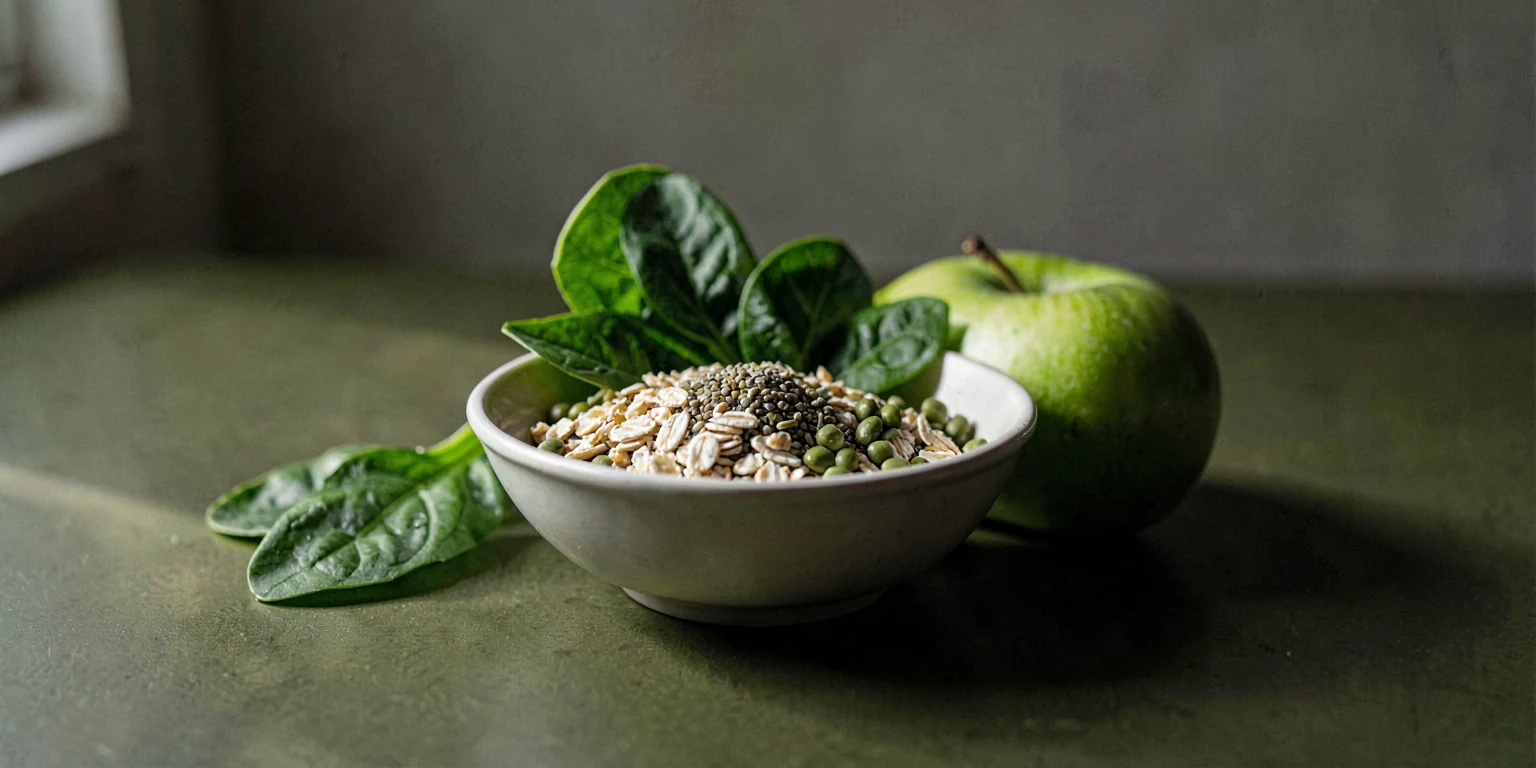
The amount is not exotic. It is a bowl of oats in the morning, beans or lentils in one meal, a couple of pieces of fruit, and bread that says whole grain. Intake still falls below recommended levels worldwide,2 and nobody needs a special product to reach it.
The biggest reduction in risk sat in that band.1 The same review's curves suggested intakes above it might help even more, so 25 to 29 grams is where the evidence is strongest, not a proven ceiling.1
The size of the evidence behind fiber
Two things make the fiber case strong: how many people it rests on, and how consistently it points one way.
Compare the people who ate the most fiber with the people who ate the least. Death from any cause and death from heart disease were 15 to 30% lower in the top group, along with new cases of heart disease, stroke, type 2 diabetes and bowel cancer.1 Clinical trials moved the in-between numbers the same way, lowering body weight, blood pressure and total cholesterol.1
A 2025 review stacked the existing analyses on top of each other and reached 17,155,277 people.2 Of the 33 analyses it collected, 29 found higher fiber intake tracking with lower disease risk.2 The strongest grade of evidence came out for death from heart disease, pancreatic cancer and diverticular disease.2
That grade is worth reading slowly. The same team's earlier pass, seven years before, awarded the top grade to only 3 of 21 outcomes.3 What changed in between was the volume of analysis, not its kind. Nearly all of it still rests on people who chose how they eat, and heavy fiber eaters differ from light ones in a hundred ways nobody measured.
Two ways to change a gut
There are two routes to changing what lives in your intestine. Bring in new organisms, or feed the ones already there. Probiotics do the first; fiber does the second.
Fiber is the feeding route, and it has its own trials. In people with type 2 diabetes, added fiber raised the share of Bifidobacterium against placebo, by a mean difference of 0.72.4 One clinical number followed. Long-term blood sugar, read as glycated hemoglobin, came out 0.18 lower.4 Fasting glucose did not move, and neither did insulin resistance.4 Side effects were no more common than on placebo, which is worth knowing for anyone who has been told that more fiber always means more trouble.4
The catch is what gets measured. A bacterial count is a stand-in for health, not health itself. The count went up dependably and most of the outcomes people care about stayed where they were. The population evidence and the bacterial evidence are two separate stories that happen to point the same way.
What the probiotic trials in healthy people measured
Sixty-three healthy adults aged 65 and over took either a capsule holding two Bifidobacterium strains or a placebo, for 12 weeks.5 The capsule group did better than placebo on a test of mental flexibility and on a stress score.5 That is a real result. It is also one pair of strains, in a small group, over three months, on outcomes nobody shops for.
The larger trial gave 169 middle-aged and older adults Lactobacillus rhamnosus GG or a placebo for three months.6 Its main finding was not that the capsule worked. It was that certain gut organisms tracked with mild memory and thinking problems, and that among the affected participants a drop in one organism went with a better score.6 A correlation inside part of one trial is a lead, not a finding.
Both trials enrolled older adults. Neither tested what most shoppers actually want, which is a general digestive tune-up for someone who is basically fine.
Set the two side by side. Fiber has millions of people behind population outcomes2 and a band where the benefit is biggest.1 Probiotics have single trials of dozens to a few hundred people, each testing one strain combination, in one group, for one outcome.5,6 That gap is not proof that probiotics do nothing. It describes which questions have been asked, and how often.
Where the fiber case thins out too
Fiber does not win every comparison. A 2024 review came at fiber and mood from both directions. In 23 studies that simply watched what people ate, covering 181,405 people, higher fiber went with slightly lower depression and anxiety scores.7 Then it turned to the experiments: ten trials, all using supplements rather than food, and no difference from placebo for either depression or anxiety.7 The survey effects were small, but their ranges stayed below zero: -0.11 for depression, with a range from -0.16 to -0.05. The trial estimate was larger, -0.47, but its range ran from -1.26 to 0.31, so it includes no effect at all.7
Notice the shape, because it repeats across nutrition. Something in the observed diets, nothing in the capsules. Only one of those ten trials enrolled people with a diagnosis of depression.7 Fiber's good evidence is for eating fiber, judged against hard outcomes. It is not evidence that a fiber powder lifts a mood.
What is still unknown
Nothing here compares the two approaches head to head. The order argued above is read off the relative weight of two bodies of work, not off a trial that put them against each other.
Which fibers carry the effect is open. The 2025 review closes by asking for work on specific fiber types, which is an admission that fiber in these studies is a category rather than a substance.2
Whether the bacterial shift explains anything downstream is open too. Bifidobacterium rises, one blood sugar marker edges down, and the rest holds still.4 The chain from a bacterial count to a longer life is argument, not measurement.
And none of this ran long. Twelve weeks, or three months, with nobody followed once the powder or the capsules ran out.5,6
QUESTIONS THIS POST ANSWERS
- Do I need a probiotic if I already eat plenty of fiber?
- Nothing in this evidence set compares the two, so there is no trial answer. What the record shows is a difference in scale: fiber intake has been tracked against disease outcomes in 17,155,277 individuals, while the probiotic trials here enrolled 63 and 169 people for twelve weeks and three months. A strain with trial evidence for a specific complaint is a different proposition from a general tonic.
- How long does a higher fiber intake take to change the gut?
- The fiber trials that measured bacteria in people with type 2 diabetes found Bifidobacterium abundance higher than placebo, with a mean difference of 0.72. The abstracts do not report how quickly that shift appeared, so a time course cannot be given from this set. The probiotic trials here ran twelve weeks and three months, and the fiber abstracts give no duration.
REFERENCES
Each reference was re-checked against PubMed before publication. How sources are checked
- 1Reynolds A, et al. Carbohydrate quality and human health: a series of systematic reviews and meta-analyses. Lancet (London, England). 2019. Source
- 2Veronese N, et al. The impact of dietary fiber consumption on human health: An umbrella review of evidence from 17,155,277 individuals. Clinical nutrition (Edinburgh, Scotland). 2025. Source
- 3Veronese N, et al. Dietary fiber and health outcomes: an umbrella review of systematic reviews and meta-analyses. The American journal of clinical nutrition. 2018. Source
- 4Ojo O, et al. The Role of Dietary Fibre in Modulating Gut Microbiota Dysbiosis in Patients with Type 2 Diabetes: A Systematic Review and Meta-Analysis of Randomised Controlled Trials. Nutrients. 2020. Source
- 5Kim CS, et al. Probiotic Supplementation Improves Cognitive Function and Mood with Changes in Gut Microbiota in Community-Dwelling Older Adults: A Randomized, Double-Blind, Placebo-Controlled, Multicenter Trial. The journals of gerontology. Series A, Biological sciences and medical sciences. 2021. Source
- 6Aljumaah MR, et al. The gut microbiome, mild cognitive impairment, and probiotics: A randomized clinical trial in middle-aged and older adults. Clinical nutrition (Edinburgh, Scotland). 2022. Source
- 7Aslam H, et al. Fiber intake and fiber intervention in depression and anxiety: a systematic review and meta-analysis of observational studies and randomized controlled trials. Nutrition reviews. 2024. Source