Do probiotics survive the stomach, and does it matter?
Whether a probiotic turns up in stool depends on the strain, except above 10 billion CFU a day, when every strain was recovered. The trials that found benefit did not need colonization.
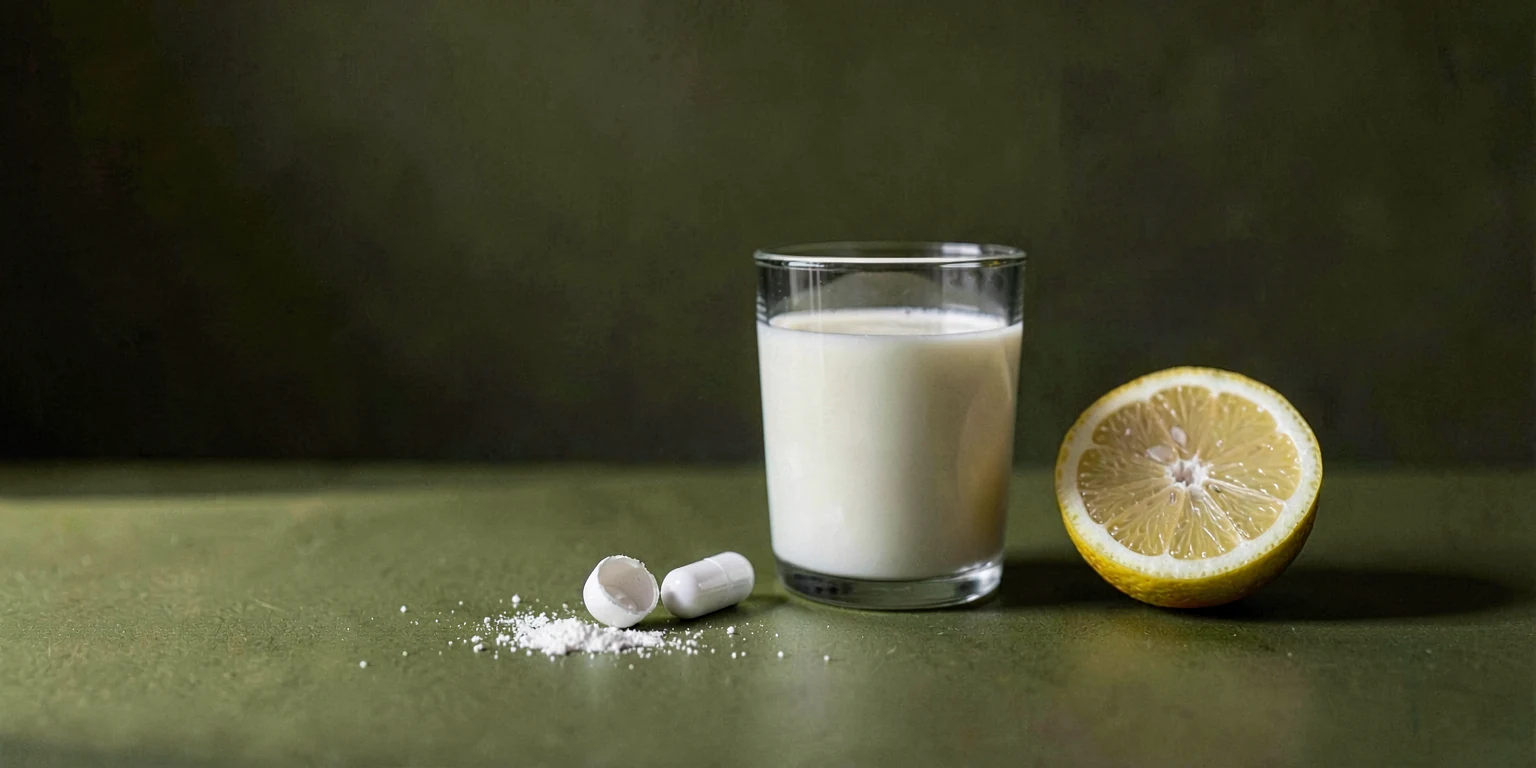
Some strains do, and some do not. In studies of healthy adults, whether a probiotic turned up in stool came down to the strain, except above 10 billion live bacteria a day, where every strain was recovered.1 The trials that found a real benefit did not need the bacteria to stay.
What "survival" means in these studies
Nobody watches a capsule dissolve inside a living stomach. The survival studies work from the far end instead. Volunteers take a strain for days or weeks, and their stool is then cultured or screened for that strain's DNA. If it shows up, the bacteria got through acid, bile and the small intestine in numbers large enough to detect. That is all fecal recovery means.
A 2021 review gathered those studies: 17 that used a single strain and 13 that used several.1 Recovery from stool, and persistence after the course ended, were strain dependent.1 The same dose of two different strains gave two different answers.
Dose overrode strain only at the top end. Above 10 billion colony-forming units a day, which is the count of living bacteria a label reports, the strain came back in stool whatever it was.1 How long the course ran made no difference at all.1 The reviewers' conclusion was blunt. The minimum doses regulators use to define a probiotic are lower than what a strain needs to survive, persist and work.1
A hardy strain can undercut that threshold
In a crossover trial, healthy volunteers took at least 1 billion colony-forming units a day of one Lacticaseibacillus rhamnosus strain, a tenth of the review's cutoff.2 They took it three ways: as freeze-dried cells, in a fermented oat drink and in a fermented milk drink.2 The strain survived the trip in every one of them.2
Survival is a property of a particular strain at a particular dose. The word probiotic on a label guarantees neither.
Acid, bile and the capsule
The stomach is where most of the loss happens, and laboratory work shows how steep it is. In simulated gastric fluid, loose bacterial powder of Lactiplantibacillus plantarum held under 30% of its viability after 2 hours.3 The same bacteria pressed into enteric-coated pellets held over 70%.3
Enteric coatings are polymers that stay intact in acid and dissolve at the gentler acidity further down. In another laboratory study, gelatin capsules coated with one such polymer did not break up in simulated gastric fluid, but did in simulated intestinal fluid, and the coating process left about 95% of the cells alive.7
Those are beaker numbers. A review of pH-responsive delivery systems, while arguing for them, is candid that the field leans on simplified digestion models and on inconsistent ways of counting a living cell.6 A capsule that holds together in a beaker of acid has passed a plausibility test, not a human one. The human test is still recovery from stool.
Food changes the odds
The crossover trial is the closest thing here to an answer about taking probiotics with food. Survival was significantly higher when the strain was drunk in the fermented oat or fermented milk format than when it was swallowed as freeze-dried cells.2 Bacteria in a fermented drink arrive surrounded by protein, fat and buffering compounds that blunt the acid. Freeze-dried cells meet it more directly.
Timing was never tested. Whether a capsule taken with breakfast fares better than one taken on waking is a separate question, and none of these studies asked it. A fermented food carrying the strain beat a dry powder, and that is as far as the evidence goes.2
Does survival predict benefit?
Here the story turns. The largest body of trials on probiotics for any single purpose concerns preventing Clostridioides difficile diarrhea in people taking antibiotics. A Cochrane review brought together 38 trials with 13,179 participants.4 That diarrhea occurred in 1.6% of the probiotic groups against 3.2% of the control groups, a halving in relative terms, at low certainty.4 Diarrhea from any cause during antibiotics fell from 27.4% to 23%.4 For every 65 people given a probiotic, one case of C. difficile diarrhea was prevented.4
Yet carrying that same bacterium without symptoms barely shifted: 14.9% with probiotics against 16.2% without, a gap too small to be sure of.4 The probiotic neither cleared the pathogen nor took its place. It reduced the illness by some other route, through what it does chemically on the way past, or through effects on the gut lining that need no residency.
A review of 29 trials in 2,871 people, this time on clearing drug-resistant bacteria out of the gut, adds a second clue. Those bacteria were still present afterwards in 22% of the probiotic groups against 30.8% on placebo.5 Which probiotic was used, and which pathogen it met, changed the result. The dose did not.5
That mismatch is the thing to keep. Recovery from stool climbs with dose.1 Benefit in these trials did not follow the same curve.5
Do they colonize?
Colonize implies taking up residence, and these studies do not support that in healthy adults. The 2021 review treated recovery during dosing and persistence after stopping as two separate outcomes, and found both of them strain dependent.1
In the crossover trial, the strain was still detectable one week after the last dose, but only in some volunteers.2 Sequencing of their stool showed no meaningful change in the diversity of the microbes already living there, which the researchers call the expected result in healthy people.2
A visitor, then, rather than a new tenant. A strain passes through, is detectable while it does, lingers a while in some people, and leaves the resident community much as it found it. The benefits recorded in trials sit comfortably with that, because none of them depended on the visitor staying.4
What remains unknown
The most practical question, whether the timing of a capsule around meals changes survival, has not been tested here. The food finding comes from one strain in one crossover trial.2 The laboratory models that make enteric coatings look decisive are simplified, and the field has not agreed on how to count a living cell.6
Recovery from stool proves passage, not activity, so a strain found in stool may have done nothing on the way through. And the benefit trials are not clean. In the Cochrane review, around 30% of the studies had no published protocol or registration, and 28 had authors affiliated with, or funded by, a probiotic company.4
The title asks two questions. The evidence answers the second more clearly than the first. Survival varies by strain and by dose, and benefit, where it exists, has not depended on it.
QUESTIONS THIS POST ANSWERS
- Should probiotics be taken with food or on an empty stomach?
- None of the trials here compared taking a capsule before or after a meal. The nearest evidence is a crossover trial in healthy volunteers, where survival of one strain through the gut was significantly higher when it was delivered in a fermented oat or milk drink than as freeze-dried cells. Food around the bacteria helped; the timing of the capsule itself was not tested.
- Do probiotics permanently colonize the gut?
- Not in these studies. Persistence after a course ended was strain dependent in the systematic review, and in the crossover trial the strain was still detectable in only a subset of volunteers one week after the last dose. The overall diversity of the microbiota did not change.
REFERENCES
- 1Morelli L, Pellegrino P. A critical evaluation of the factors affecting the survival and persistence of beneficial bacteria in healthy adults. Beneficial microbes. 2021. Source
- 2Mangieri N, et al. Effect of the Food Matrix on the Survival to the Gastrointestinal Transit of Lacticaseibacillus rhamnosus CRL1505: A Randomized, Controlled, Crossover Study. Molecular nutrition & food research. 2025. Source
- 3Zhang X, et al. Sustained-release enteric formulations of Lactiplantibacillus plantarum based on granulation technology: preparation and therapeutic evaluation in acute colitis. BMC biotechnology. 2026. Source
- 4Esmaeilinezhad Z, et al. Probiotics for the prevention of Clostridioides difficile-associated diarrhea in adults and children. The Cochrane database of systematic reviews. 2025. Source
- 5Rahman MN, et al. The use of probiotics and prebiotics in decolonizing pathogenic bacteria from the gut; a systematic review and meta-analysis of clinical outcomes. Gut microbes. 2024. Source
- 6Feng Y, et al. Engineering pH-responsive probiotic carriers for oral delivery: Design principles, gastrointestinal fate, and translational perspectives. Food research international (Ottawa, Ont.). 2026. Source
- 7Fredua-Agyeman M. Surviving process and transit: Controlled freeze drying, storage and enteric coated capsules for targeted delivery of probiotic Lactobacillus acidophilus . Heliyon. 2024. Source