Psyllium, kiwifruit, prunes: constipation relief ranked by the trials
Trials on psyllium, kiwifruit, prunes, water and magnesium measured different things in different people. Here is what each one actually moved, and how fast.
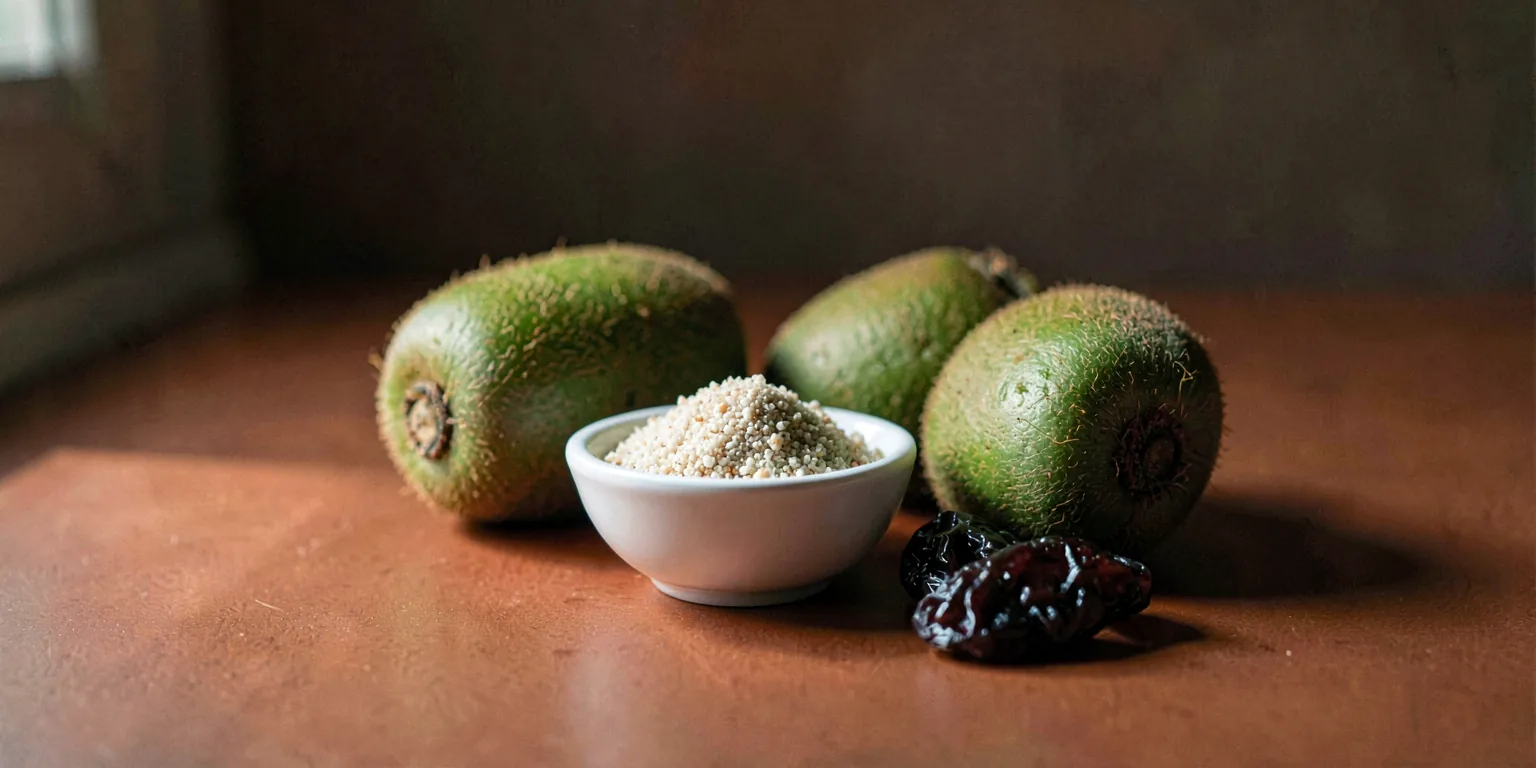
Psyllium is the fiber the trials trust most, and it is also the yardstick everyone else gets measured against. Kiwifruit edges past it by about a third of a bowel movement a week.2 Prunes tie it.2 Magnesium oxide beats all of them, adding almost four extra bowel movements a week in one trial.4 Water alone does none of this.5
What the trials actually counted
Nearly every trial here uses the same yardstick: how many spontaneous bowel movements a person has in a week, compared with a placebo, a comparator food, or nothing. Some also score stool consistency on a standard scale that runs from hard pellets to watery, and a few track straining or abdominal pain. None of them measure how a person feels about their gut in general, which is worth keeping in mind before treating any of these numbers as the whole story.
That matters because a trial can show a real difference in stool frequency while telling a reader almost nothing about comfort or urgency. Weekly counts are cheap to measure and easy to pool across studies. That is why they dominate this evidence base, not because they are the outcome that matters most to someone living with constipation.
Sixteen trials with 1,251 adults gave fiber supplements, mostly psyllium, and found 66% of the fiber group responded against 41% on control.1 That gap only showed up reliably at doses above 10 grams a day, taken for at least four weeks.1 Below that dose, or in shorter trials, the fiber groups looked more like the control groups. Fiber also came with a cost the response numbers do not show. People taking it reported more bloating and gas than the control groups did, a side effect trial summaries mention rarely and headlines almost never.
Kiwifruit and prunes, measured against psyllium
A 2024 review pooled the food trials directly against psyllium rather than against a placebo, which is the more useful comparison for someone choosing between a bowl of fruit and a scoop of husk. Fruit, mostly kiwifruit, added 0.36 more bowel movements a week than psyllium did.2 Prunes came out even with psyllium, not better and not worse.2
Kiwifruit's own trial record is thinner than the headline suggests. Against a placebo, kiwifruit extract added 1.36 bowel movements a week, but the certainty behind that number was rated low.3 A separate analysis that used whole kiwifruit, not extract, found no measurable change in stool frequency at all, though it drew on only three small trials.4 Two datasets, both real, pointing in different directions on the same fruit.
Where magnesium pulled ahead
Magnesium oxide is the outlier in this comparison, and it comes from a supplement trial rather than a food trial. Sixty-eight percent of people on magnesium oxide responded, against 19% on control.4 Stool frequency rose by 3.72 bowel movements a week, more than any fruit or fiber figure here.4 Consistency improved too, by just over one point on the standard stool scale.4
That result rests on a small base: two trials feeding into the magnesium number, the same size of evidence that produced the shakier kiwifruit findings above. A big effect from a small trial pool is not a reason to dismiss it, but it is a reason to want more trials before ranking magnesium above everything else. Magnesium oxide also works by a different route than fiber. Fiber adds bulk and holds water in the stool; magnesium oxide draws water into the bowel by osmosis, closer to how a laxative works than how a food does. That distinction is part of why it moved the largest numbers here.
Water does not move the numbers
Water gets recommended by habit more than by evidence. A review of nonpharmacologic constipation treatments in children looked specifically at fluid intake and found no benefit. Plain water did not increase stool frequency, and even a hyperosmolar drink, one built to draw water into the gut, did no better.5 That result covers topping up an already adequate intake, not correcting dehydration, which is a different problem with different physiology.
Where the ranking gets shaky
Every number above comes from a different pool of trials, run in different people, over different lengths of time, which makes a clean ranking harder to defend than it looks. The fiber meta-analysis flagged considerable heterogeneity in its own pooled results, meaning the individual trials disagreed with each other more than chance would explain.1 The kiwifruit-versus-placebo figure carries low-certainty evidence by the reviewers' own grading.3 None of these trials ran head-to-head against magnesium oxide, so "magnesium beat everything" really means "magnesium beat control by more than the others beat their own controls," which is a weaker claim.
What remains unknown
Trial length is the biggest gap. The fiber meta-analysis found its effect only past four weeks, and shorter trials mostly failed to show a difference.1 Nobody has published a trial that says what happens after three or six months of any of these approaches. Dose is the second gap: the fiber threshold sat above 10 grams a day, but none of the fruit trials reported precise daily fiber content, so a kiwifruit-for-psyllium swap is not really a dose-matched comparison.1 And the magnesium result, the largest number in this whole comparison, rests on the fewest trials of any figure cited here.4 What survives is a rough order, not a settled one. Psyllium works reliably past a month at a real dose, kiwifruit and prunes come close to it, magnesium oxide moved the biggest numbers on the smallest evidence base, and extra water by itself did not show up in the data at all.
QUESTIONS THIS POST ANSWERS
- Does drinking more water help constipation on its own?
- Not on the evidence available. A review of nonpharmacologic treatments in children found no evidence that plain water intake increased stool frequency or made stools easier to pass, and extra fluid on top of a normal intake did not do better than a hyperosmolar drink. Fluid replacement matters when someone is dehydrated, but topping up an already normal intake does not appear to move the numbers trials track.
- How long does psyllium take to work?
- The largest analysis of fiber trials found benefits only at doses above 10 grams a day and only after at least four weeks of treatment; shorter trials and lower doses were less likely to show a difference. That does not mean nothing happens in week one, only that the pooled evidence is built mostly from trials that ran a month or longer at a meaningful dose.
REFERENCES
Each reference was re-checked against PubMed before publication. How sources are checked
- 1van der Schoot A, et al. The Effect of Fiber Supplementation on Chronic Constipation in Adults: An Updated Systematic Review and Meta-Analysis of Randomized Controlled Trials. The American journal of clinical nutrition. 2022. Source
- 2Van Der Schoot A, et al. Systematic review and meta-analysis: Foods, drinks and diets and their effect on chronic constipation in adults. Alimentary pharmacology & therapeutics. 2024. Source
- 3Eltorki M, et al. Kiwifruit and Kiwifruit Extracts for Treatment of Constipation: A Systematic Review and Meta-Analysis. Canadian journal of gastroenterology & hepatology. 2022. Source
- 4van der Schoot A, et al. The effect of food, vitamin, or mineral supplements on chronic constipation in adults: A systematic review and meta-analysis of randomized controlled trials. Neurogastroenterology and motility. 2023. Source
- 5Tabbers MM, et al. Nonpharmacologic treatments for childhood constipation: systematic review. Pediatrics. 2011. Source