The Mediterranean diet: what the trials actually tested
Trials built the Mediterranean diet around two things: olive oil or nuts for fat, and plenty of plant foods. Most of what people add on top was never the part being tested.
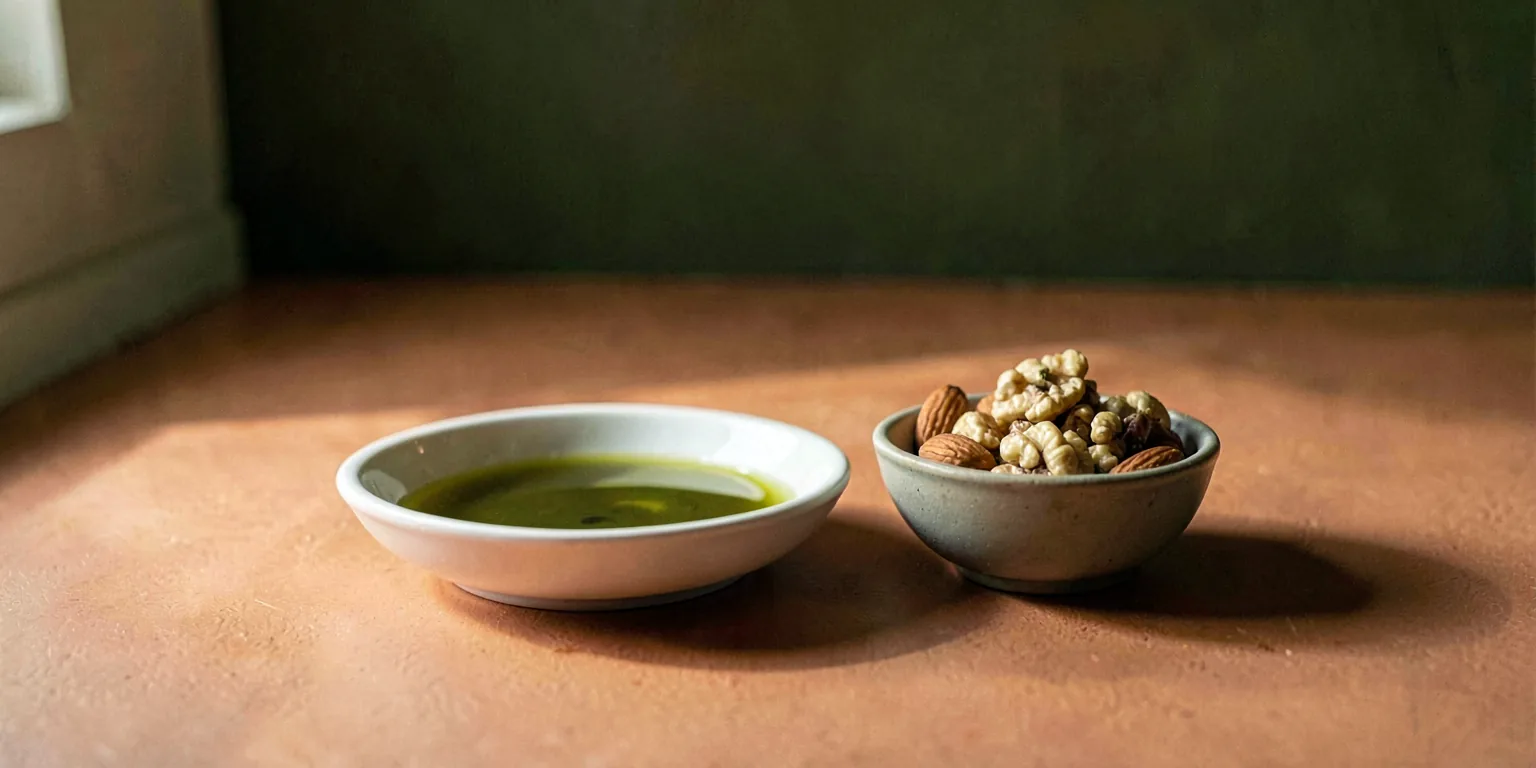
The tested version of the Mediterranean diet is narrower than the postcard version. Trials built it around two things: olive oil or nuts as the main fat, and plenty of plant foods. In the largest trial on it, that approach cut strokes from 24 in 1,000 people down to 14.1 Deaths from heart disease did not move.
What actually counted as "the diet"
A large review of these trials set a working definition. It has only two required parts. One is a high ratio of olive oil or other monounsaturated fats to saturated fat. The other is a high intake of plant foods: vegetables, fruit, legumes.1
Everything else on the usual list was optional. Wine, whole grains, less meat, more fish, moderate dairy: the review filed all of those as additional, not required.1 A trial participant could meet the tested definition on olive oil, nuts and vegetables alone, without touching a glass of wine or a piece of fish.
That matters because most articles about this diet lead with the extras. The trials did not. The extras were add-ons some study arms happened to include, not the ingredient being measured.
The trial that anchors most of the evidence
The biggest single study behind this diet is called PREDIMED. Researchers gave one group advice to follow the pattern, plus a free supply of either extra-virgin olive oil or tree nuts. They compared that group with people told to eat a low-fat diet. The trial was later retracted and re-analysed over concerns about how people were assigned at two of its 11 sites, and the figures here come from the re-analysis.1
Over roughly five years, death from heart disease did not fall clearly. Death from any cause did not fall either.1 What did fall was strokes, from 24 to 14 per 1,000 people, a difference the reviewers rated moderate-quality evidence.1
One outcome moved. Two did not. That split is the honest headline, not a clean win. It is also the reason a single trial, however large, should not be read as proof the whole diet extends life.
Where a bundle of trials agrees
Zoom out to four separate randomized trials, more than 10,000 people combined, followed for two to seven years, and the picture firms up somewhat. People on the Mediterranean pattern had about half the odds of a combined outcome that bundled heart attack, stroke and cardiac death, compared with people on a control diet.2 The trials disagreed with each other a good deal, so treat that size as rough.
Weight moved too, though more modestly. Four reviews of randomized trials, pooling up to sixteen trials, found people following the Mediterranean pattern lost more body weight and dropped their body mass index further than people on comparison diets.3
Blood markers move even where hard outcomes don't
In people who already have type 2 diabetes, eleven trials found the Mediterranean diet nudged blood sugar control down, lowered fasting glucose, and trimmed both body mass index and LDL cholesterol. Diastolic blood pressure dipped slightly too.4 None of these are stroke or death. They are the numbers a routine blood test reports back.
Children showed a similar pattern on a shorter clock. Nine trials in kids and teenagers, running about seventeen weeks on average, found lower blood pressure, lower triglycerides, lower total and LDL cholesterol, and higher HDL cholesterol next to a control diet.5 Triglycerides fell by 16.42 mg/dL, with a range from -27.57 to -5.27. Total cholesterol fell by 9.06, with a range from -15.65 to -2.48. LDL fell by 10.48, with a range from -17.77 to -3.19, and HDL rose by 2.24, with a range from 0.34 to 4.14.5
Blood sugar and insulin measures did not move in that group.
Why the olive oil keeps showing up
The diet's own centerpiece carries a plausible reason for at least part of this pattern. Olive oil contains plant compounds called oleuropein, hydroxytyrosol and tyrosol. A pooled analysis of fourteen small trials found that supplementing with these three compounds alone lowered total cholesterol, triglycerides and insulin by modest amounts.6
That is a mechanism study on isolated compounds, not proof that the whole diet's effect runs through them. But it lines up with putting olive oil at the center of the definition rather than at the edge of a food list. It also fits why the trials name olive oil rather than fat in general, though none of the trials here compared olive oil with another oil.
What remains unknown
The strongest single trial found nothing on total or heart-disease death, only on stroke.1 A diet that changes one hard outcome and not two others is real evidence, not proof of a broad protective effect on how long someone lives.
The systolic blood pressure finding in people with diabetes crossed the line where a result stops being distinguishable from no effect at all.4 Some of what gets reported as a benefit of this diet sits right on that edge, and a slightly different group of trials could tip it either way.
Duration is thin almost everywhere. The children's trials averaged seventeen weeks.5 Nothing here says what following this pattern for a decade does to a person's risk, only what a few months to a few years did to blood tests, and, in one large trial, to strokes.
What survives all of that is a diet defined narrowly around olive oil and plant foods, tested mostly in adults already at cardiovascular risk, that changed several blood numbers and one hard outcome in one major trial. Wine, fish and the rest of the popular picture were never what was actually being measured.
QUESTIONS THIS POST ANSWERS
- Is wine part of the Mediterranean diet evidence?
- Not in the way the diet was actually defined for trials. The Cochrane review that set the working definition required only two things: a high ratio of olive oil or other monounsaturated fats to saturated fat, and a high intake of plant foods. Low to moderate red wine consumption was listed only as an additional, optional component, alongside whole grains and dairy. Wine was never one of the two required parts of the tested diet.
- Can you follow the Mediterranean diet without eating fish?
- By the trial definition, yes. Increased fish consumption sat in the same additional, optional category as wine and whole grains, not among the two required components: the olive oil or nut-based fat ratio and a high intake of plant foods. A trial participant could meet the definition researchers used without changing how much fish they ate.
REFERENCES
Each reference was re-checked against PubMed before publication. How sources are checked
- 1Rees K, et al. Mediterranean-style diet for the primary and secondary prevention of cardiovascular disease. The Cochrane database of systematic reviews. 2019. Source
- 2Sebastian SA, et al. Long-term impact of mediterranean diet on cardiovascular disease prevention: A systematic review and meta-analysis of randomized controlled trials. Current problems in cardiology. 2024. Source
- 3Dominguez LJ, et al. Mediterranean diet in the management and prevention of obesity. Experimental gerontology. 2023. Source
- 4Wu MJ, et al. Impact of the Mediterranean Diet on Glycemic Control, Body Mass Index, Lipid Profile, and Blood Pressure in Type 2 Diabetes: A Meta-Analysis of Randomized Controlled Trials. Nutrients. 2025. Source
- 5López-Gil JF, et al. Mediterranean Diet and Cardiometabolic Biomarkers in Children and Adolescents: A Systematic Review and Meta-Analysis. JAMA network open. 2024. Source
- 6Frumuzachi O, et al. The impact of oleuropein, hydroxytyrosol, and tyrosol on cardiometabolic risk factors: a meta-analysis of randomized controlled trials. Critical reviews in food science and nutrition. 2025. Source