Can you boost your metabolism? What the trials measured
Lifting weights raised resting metabolism by about 96 calories a day. Green tea added roughly 38. Eating more often changed nothing at all.
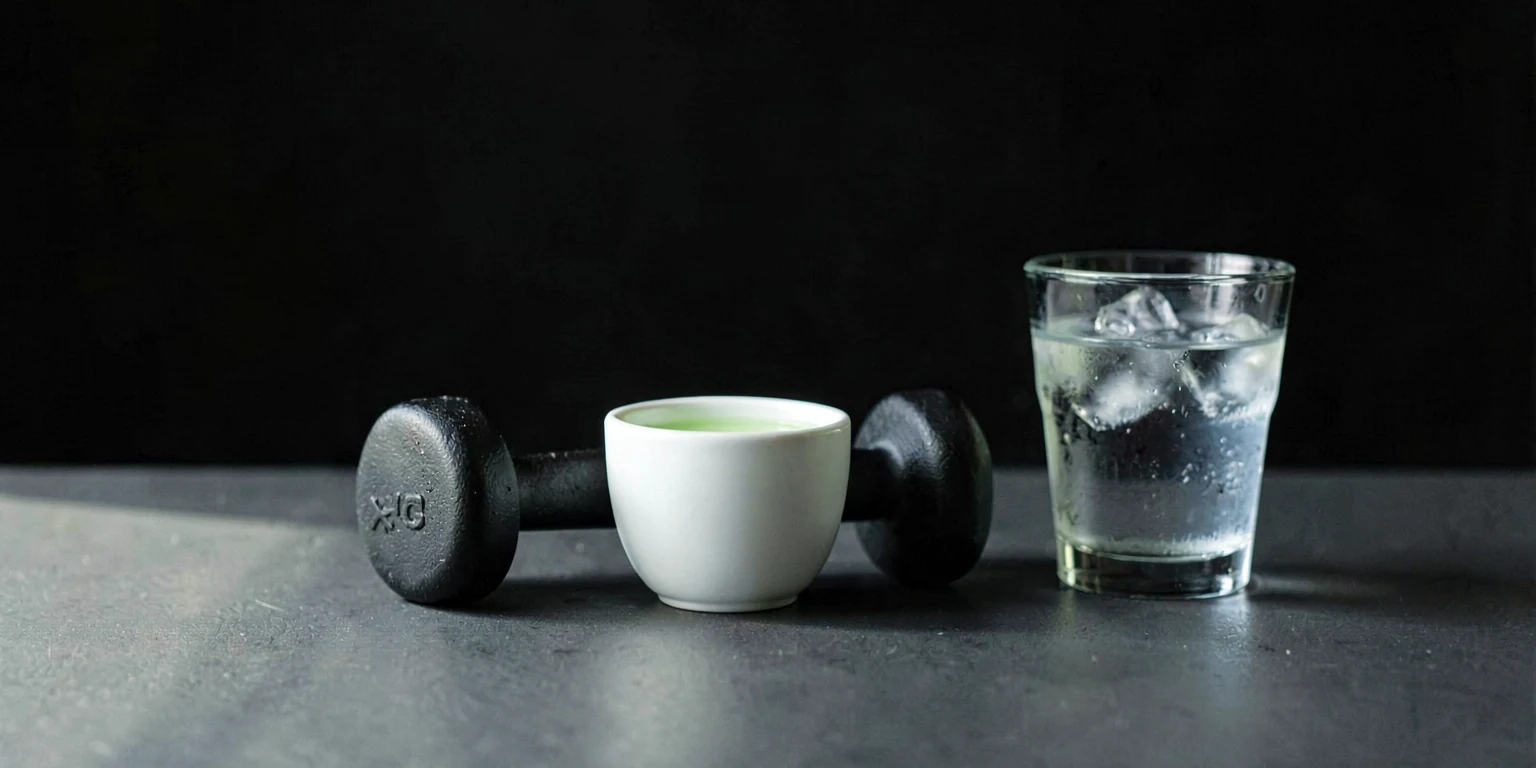
Barely, and only by one route the trials could measure. Lifting weights raised the energy people burn at rest by about 96 kcal a day. Cardio did not.1 Green tea catechins added a fraction of that.2 Eating small, frequent meals changed nothing at all when people were shut in a measuring chamber for a day.3
What is actually being measured
Metabolism, in the sense the word is sold, means the energy your body spends doing nothing. That is a real quantity, and it can be read off an instrument. Lie still after an overnight fast and a machine measures the oxygen you take in and the carbon dioxide you breathe out. The volume and the ratio between them give the calories you are burning while lying there.
For a whole day, the person is shut in a sealed room where every breath is accounted for, along with every meal, nap and walk across the floor.3 These are the instruments behind everything below, and they turn a vague promise into a number with a unit.
The unit matters, because the size of these claims is rarely said out loud. A booster that adds a few dozen kilocalories a day is real and small. One that adds nothing is common. The chamber tells them apart.
Resistance training: the one that held up
The cleanest test came from a review that collected exercise trials measuring resting metabolic rate, checked how carefully each had taken the measurement, and set aside older adults, pregnant women and people with conditions that alter metabolism.1 Lumped together, exercise did not raise resting metabolic rate at all.1
Split by type, the picture changed. Aerobic exercise on its own shifted the resting rate by 81.65 kcal a day, a figure too unsteady to call real.1 Resistance exercise raised it by 96.17 kcal a day against controls, and that one held.1
Ninety-six kilocalories is the gap between two people of the same size, one of whom lifts, both lying still.1 It is not a large number. It is the largest number in this article. And it comes from trials whose methods varied widely and whose risk of bias the reviewers rated high, so treat it as the best-supported effect here rather than a precise one.1
Green tea: small, and close to the edge
The compound behind the claim is epigallocatechin gallate, the main catechin in green tea, usually shortened to EGCG. Across the trials it raised daily energy expenditure by 158.05 kJ against placebo, which is about 38 kcal — well under half of what lifting delivered.2 At the bottom of its range the effect is indistinguishable from zero.2
There is a second reason for caution. The result came from the less conservative of the two standard ways of combining trials, the one that assumes every study is measuring the same underlying thing. The reviewers' own summary is modest. EGCG moderately accelerates energy expenditure, may raise metabolic rate on its own at a 300 mg dose, and needs large trials to confirm.2 A 300 mg dose is supplement territory, not one cup of tea.
The marker for fat burning shifted slightly in the expected direction. The amount of fat actually burned did not change reliably.2
Small frequent meals: measured, and nothing there
The idea that eating often keeps a metabolic fire burning has been tested the most direct way available. Shut people in the chamber, feed them identical food on different schedules, and read the meter.
In one such study, adults ate the same food as either three meals or six, on two separate days. Energy expenditure over 24 hours came out at 8.7 megajoules against 8.6.3 That is the same day's burn, twice. Fat burning was identical as well.3 What did differ was appetite: people were hungrier on six meals than on three.3
A second chamber study ran the comparison in the other direction, two meals against three. Three meals instead of two changed nothing about 24-hour expenditure, the heat thrown off by digesting food, the energy spent moving, or the rate burned during sleep.4 It did raise fat burning and leave people more satisfied across the day, which is an argument for eating lunch rather than evidence of a faster metabolism.4
Even inside a single morning, splitting food up did not help. A 750 kcal drink was given either in one go or as five 150 kcal portions half an hour apart. Energy expenditure over the next 2.5 hours was higher after the single drink, the fullness hormone GLP-1 rose higher, and hunger was better suppressed.5 The researchers' conclusion was that nibbling does not keep expenditure up.5
Regularity is a different question from frequency, and it fared better. Women ate on a fixed schedule for two weeks, then on an erratic one for two weeks. On the regular pattern they produced a greater heat response to a test meal, ate less, and had lower fasting cholesterol, 4.16 against 4.30 mmol/L.6 A predictable pattern did something measurable. Adding meals did not.3,6
Cold exposure and cold water
Cold has the best mechanism story of the lot. Shivering burns energy, and brown fat exists to turn calories into heat. But no trial in the evidence gathered for this article measured cold exposure or cold water against energy expenditure. So this piece cannot put a number on it and will not invent one. The claim is unmeasured here, which is not the same as being false.
The direction metabolism usually moves
Most people asking how to boost their metabolism are dieting, and dieting pushes the number the other way. Trials comparing continuous calorie restriction against intermittent dieting with planned breaks found similar losses of weight and fat either way. But resting metabolic rate fell significantly only under continuous restriction, and building in breaks blunted the drop.7 The protection was greater in people carrying more weight than in resistance-trained people.7
That reframes the question worth asking. During weight loss, the realistic goal is not raising resting expenditure. It is losing less of it, and diet breaks are one measured way to do that.7 Lifting is the only thing here that moved the number up.1
What remains unknown
The resistance-training figure comes from trials with varied methods and a high risk of bias, and a resting measurement cannot say how much of the gain is simply new muscle sitting there.1 The green tea effect leans on the more generous statistical model, sits near zero at the bottom of its range, and has never been confirmed in a large trial.2
The meal-frequency work is small and short, a dozen-odd people over a day or two, which is enough to rule out a large effect and not enough to rule out a subtle one.3,4 Cold was not measured here at all. And nothing followed anyone long enough to say whether 96 kcal a day, or a shallower decline while dieting, changes what the scale reads in a year.1
QUESTIONS THIS POST ANSWERS
- Does eating small frequent meals speed up metabolism?
- Not in the trials that measured it. In a whole-room calorimeter, three meals and six meals a day produced the same 24-hour energy expenditure, and six meals left people hungrier. Splitting one drink into five small portions produced lower energy expenditure over the following hours than drinking it at once.
- Does drinking cold water burn a meaningful number of calories?
- No trial in the evidence base for this article measured water temperature against energy expenditure, so it cannot put a number on it. The boosters that were measured moved daily expenditure by tens of kilocalories at most, which is the scale to keep in mind for any claim about water.
REFERENCES
- 1MacKenzie-Shalders K, et al. The effect of exercise interventions on resting metabolic rate: A systematic review and meta-analysis. Journal of sports sciences. 2020. Source
- 2Kapoor MP, et al. Physiological effects of epigallocatechin-3-gallate (EGCG) on energy expenditure for prospective fat oxidation in humans: A systematic review and meta-analysis. The Journal of nutritional biochemistry. 2017. Source
- 3Ohkawara K, et al. Effects of increased meal frequency on fat oxidation and perceived hunger. Obesity (Silver Spring, Md.). 2013. Source
- 4Smeets AJ, Westerterp-Plantenga MS. Acute effects on metabolism and appetite profile of one meal difference in the lower range of meal frequency. The British journal of nutrition. 2008. Source
- 5Ingves S, et al. A randomized cross-over study of the effects of macronutrient composition and meal frequency on GLP-1, ghrelin and energy expenditure in humans. Peptides. 2017. Source
- 6Farshchi HR, et al. Beneficial metabolic effects of regular meal frequency on dietary thermogenesis, insulin sensitivity, and fasting lipid profiles in healthy obese women. The American journal of clinical nutrition. 2005. Source
- 7Poon ET, et al. Effects of intermittent dieting with break periods on body composition and metabolic adaptation: a systematic review and meta-analysis. Nutrition reviews. 2025. Source