When to take vitamins: with food, without, and what not to pair
Vitamin D absorbed 32% better when it was swallowed with a meal containing fat. Iron is the reverse problem, and the coffee rule runs one way: before the meal is fine, after is not.
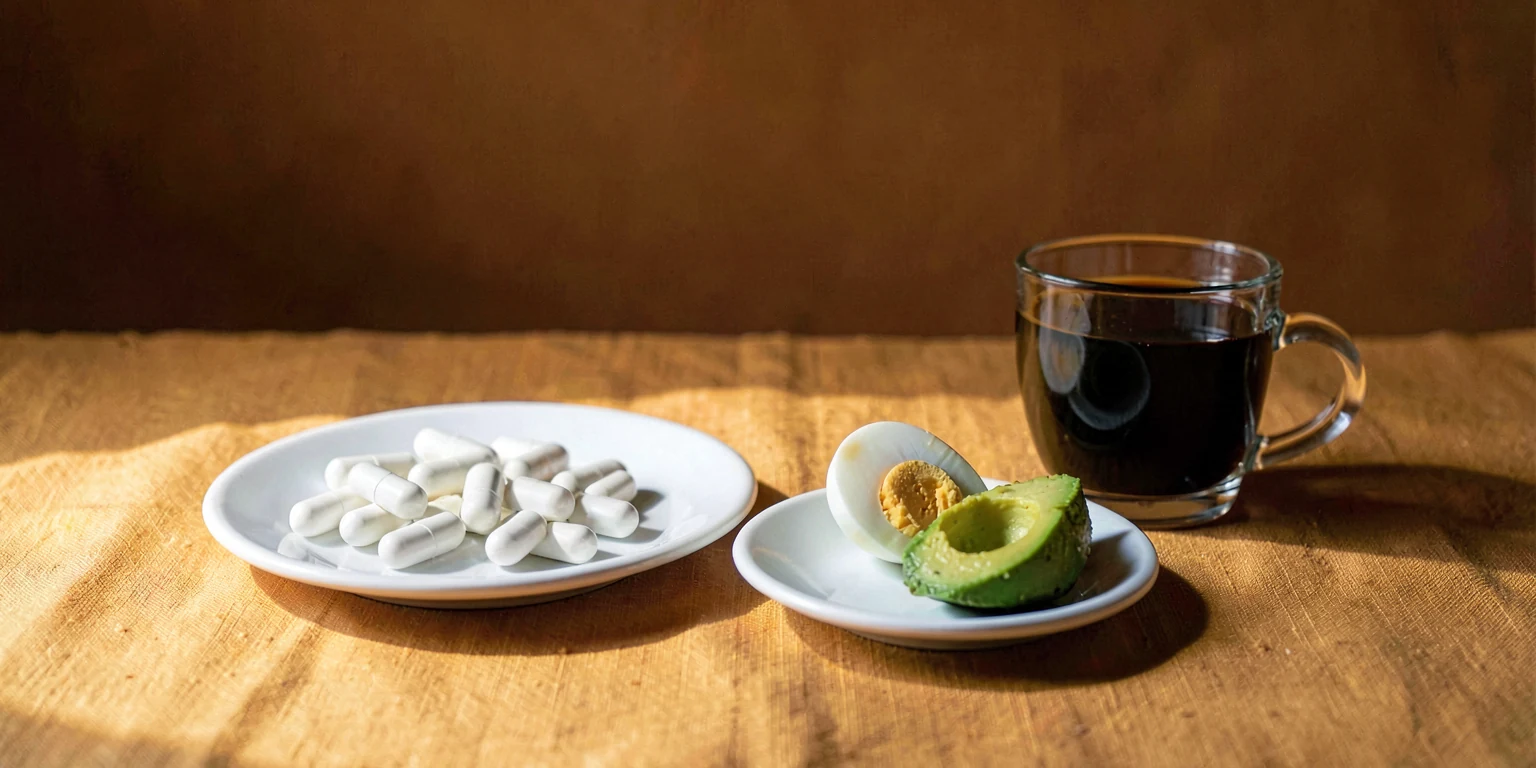
With a meal, if the vitamin is a fat-soluble one. In one experiment, a large single dose of vitamin D3 peaked 32% higher in the blood when it was swallowed with a breakfast containing fat than with a fat-free breakfast.1 Iron is the opposite problem. What matters there is what you keep it away from.
Fat-soluble vitamins and the fat in the meal
That vitamin D experiment is worth reading closely, because it was built to separate two questions.
Fifty healthy older men and women fasted for 12 hours, then took a single 50,000 IU dose of vitamin D3 with one of three test breakfasts.1 One was fat-free. The other two drew 30% of their calories from fat, one leaning toward monounsaturated fat and one toward polyunsaturated. Blood was sampled before the dose and again at 10, 12 and 14 hours.1
At the 12-hour peak, the two fat-containing groups sat 32% higher than the fat-free one, on a range from 11% to 52%.1 Which kind of fat it was made no difference at any point.1
So the requirement is fat in the meal, not olive oil in particular. Vitamins A, D, E and K all travel the same absorption route, and that is where the standing advice to take them with food comes from.
Two limits on the result are easy to skip past. The dose was one large hit rather than a daily amount. And the thing measured was vitamin D3 circulating over 14 hours, not the stored form that a blood test reports after weeks of dosing.1 Fat improves the uptake of a dose. Whether that changes anyone's vitamin D status over a winter is a different question, and this experiment did not ask it.
What actually blocks iron
Start with the scale, because it explains why iron is so easily disturbed. People take in 10 to 15 mg of iron a day from food, and only 1 to 2 mg of it gets through the gut wall.5 Everything below moves that thin margin.
Calcium, polyphenols and phytates — the storage form of phosphorus in grains and beans — sit on the blocking side. Vitamin C and protein sit on the helping side.5
Polyphenols are the strongest lever, and their effect follows the dose rather than the drink's reputation. Traced by how much iron from a bread meal ended up in red cells, drinks carrying 20 to 50 mg of polyphenols per serving cut absorption by 50 to 70%. Drinks carrying 100 to 400 mg cut it by 60 to 90%.3
Black tea took absorption down by 79 to 94%, peppermint tea by 84% and camomile by 47%.3 Herb teas are not a loophole. Adding milk made little or no difference to any of them.3
Strength matters more than category. Across five experiments in 74 people, American-style coffee did not significantly change iron absorption, while espresso and tea halved it.4 The same work found iron bis-glycinate absorbed about twice as well as ferrous sulfate, and partly shielded from the blocking effect of phytates — which is why chelated forms show up in fortified foods.4
The timing result nobody quotes
The most useful experiment here is also the oldest.
Using two forms of labeled iron, researchers found that a cup of coffee cut iron absorption from a hamburger meal by 39%, and tea cut it by 64%.2 With a stripped-down test meal, drip and instant coffee took absorption from 5.88% down to 1.64% and 0.97%. Doubling the strength of the instant coffee took it to 0.53%.2
Then comes the part that answers the practical question. Coffee drunk an hour before the meal reduced iron absorption not at all. Coffee drunk an hour after the meal blocked it just as thoroughly as coffee drunk with it.2
The window runs forward, not backward. Coffee before breakfast is not the problem. Coffee after breakfast is the same problem as coffee during it.
Which pairings genuinely conflict
Calcium earns its reputation. It sits on the list of iron blockers alongside phytates and polyphenols, so an iron tablet and a calcium tablet swallowed together work against each other.5 Vitamin C earns its reputation from the other side of the same list.5
The best-documented conflicts, though, are not between two supplements. They are between supplements and one drug.
A review of levothyroxine, the standard thyroid medication, screened 121 studies and included 63.6 It found limited but consistent evidence that coffee, soy products, fiber, calcium supplements, iron supplements and tube feeding all reduced how much of the drug was absorbed.6 Milk, juices, papaya, aluminium-containing preparations and chromium supplements changed its effect in ways the reviewers thought needed larger studies, as did an apparent boost from vitamin C.6
Their conclusion was about spacing rather than avoidance. Leave a proper gap between the drug and food — coffee, calcium and iron especially — and the interaction disappears. Morning and bedtime dosing worked equally well.6
What these studies do not settle
All of this measures uptake, not health.
The vitamin D finding is a single day in 50 people, with a blood level as the outcome.1 Nothing here followed whether taking the supplement with or without fat changed anyone's vitamin D status, let alone anything they would notice. The iron figures come from single test meals traced with labeled iron, so a 50 to 70% reduction describes that one breakfast rather than a month of breakfasts — and whether it matters at all depends on how much iron a person has to spare.3
The size of individual variation is the real gap. Common gene variants affecting how vitamins A, D and E are taken up, moved, metabolized and transported each make a small difference on their own, but combinations of them explain a meaningful share of why the same dose leaves different amounts in different people's blood.7 Those findings have not been confirmed in separate groups, so nobody can yet use them to fit a dose to a person.7
And nobody has tested the question most people actually have, which is what happens when four or five supplements go down together with the same glass of water.
QUESTIONS THIS POST ANSWERS
- Does it matter whether I take vitamins in the morning or at night?
- What the absorption studies isolate is the meal, not the hour. Vitamin D3 was absorbed 32% better with a fat-containing meal than with a fat-free one, and nothing in that experiment depended on the time of day the meal was eaten. The one systematic review here that did compare clock times, for levothyroxine rather than a vitamin, found morning and bedtime dosing equally effective.
- Can I take all my supplements at the same time?
- The absorption studies point at specific conflicts rather than a general rule. Calcium, polyphenols and phytates all inhibit non-heme iron absorption, and a cup of coffee cut iron absorption from a test meal by 39% in an isotope study. No trial in this set compared a whole stack of supplements taken together against the same supplements spaced apart.
REFERENCES
- 1Dawson-Hughes B, et al. Dietary fat increases vitamin D-3 absorption. Journal of the Academy of Nutrition and Dietetics. 2015. Source
- 2Morck TA, et al. Inhibition of food iron absorption by coffee. The American journal of clinical nutrition. 1983. Source
- 3Hurrell RF, et al. Inhibition of non-haem iron absorption in man by polyphenolic-containing beverages. The British journal of nutrition. 1999. Source
- 4Layrisse M, et al. Iron bioavailability in humans from breakfasts enriched with iron bis-glycine chelate, phytates and polyphenols. The Journal of nutrition. 2000. Source
- 5Piskin E, et al. Iron Absorption: Factors, Limitations, and Improvement Methods. ACS omega. 2022. Source
- 6Wiesner A, et al. Levothyroxine Interactions with Food and Dietary Supplements-A Systematic Review. Pharmaceuticals (Basel, Switzerland). 2021. Source
- 7Borel P, et al. Bioavailability of Fat-Soluble Vitamins and Phytochemicals in Humans: Effects of Genetic Variation. Annual review of nutrition. 2018. Source