Collagen for skin and joints: how long the trials ran, and what moved
Hydrolyzed collagen trials show firmer, more hydrated skin after about three months and eased joint aches after about twelve weeks. Industry funding, short trials and blended products limit how far those numbers can be trusted.
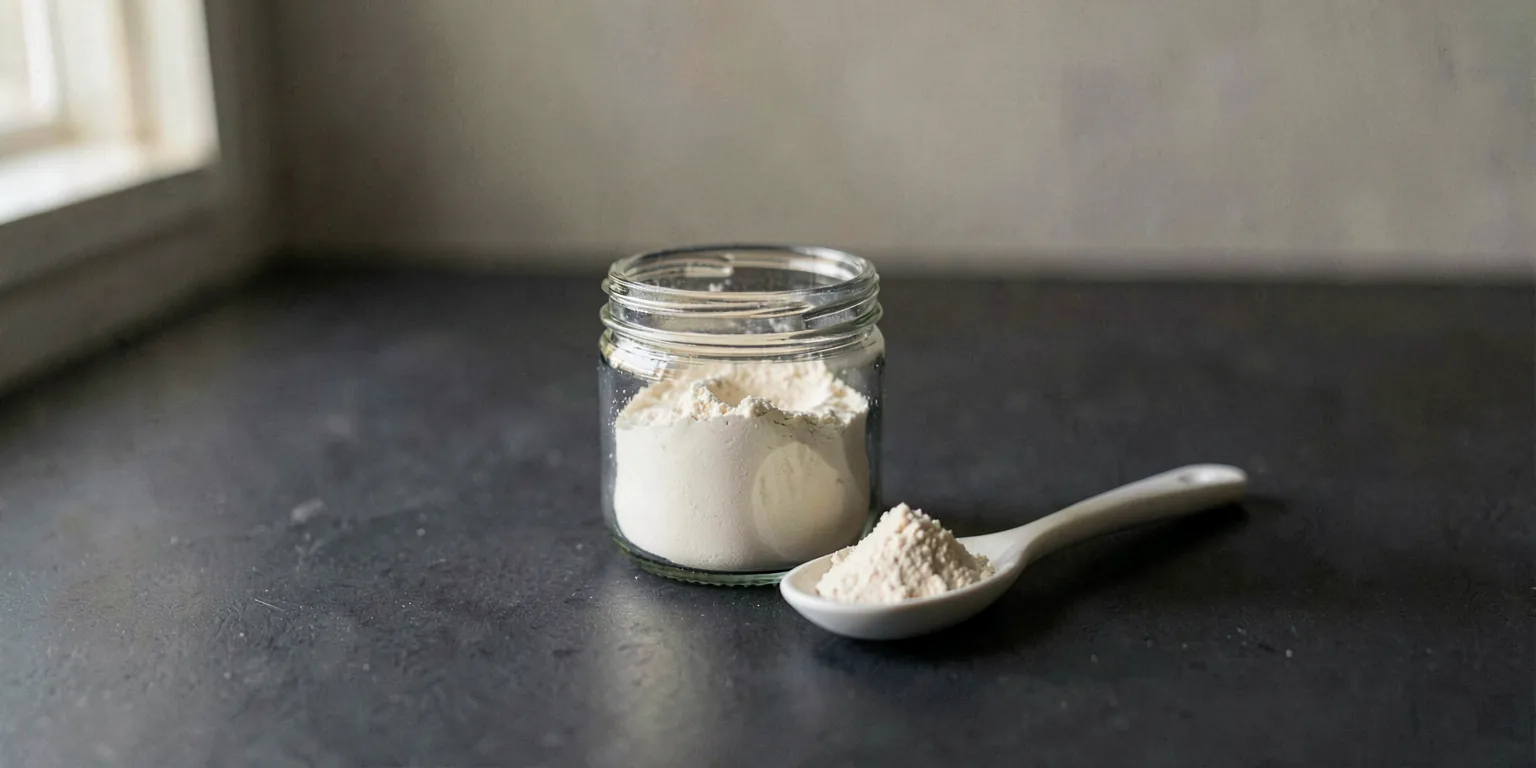
Collagen powders and capsules are sold on two promises: firmer skin and quieter joints. Both hold up in trials to a point. Skin measures improved after about three months of daily use.1 Joint aches eased after about twelve weeks in several smaller trials. The catch is who paid for much of that research.
What the skin trials measured
Skin studies compare hydrolyzed collagen against a placebo capsule or powder, over weeks to months. Instruments read hydration, elasticity, and wrinkle depth straight off the skin's surface, rather than relying on how a person feels their skin looks. The largest analysis combined 19 controlled trials on 1,125 people, nearly all women between the ages of 20 and 70.1 It found collagen ahead of placebo on hydration, elasticity, and wrinkles, and the hydration and elasticity results held up under a closer subgroup check.1
A second, larger analysis pooled 26 trials and reported the same two outcomes as statistically significant: hydration and elasticity both moved in collagen's favor.2 It also found no meaningful difference between sources of collagen, marine against other animal sources, for elasticity. Hydration results did vary by source and by how long people took it.2
How much skin actually changed, and over what stretch
Ninety days is where the largest analysis places its result. Daily hydrolyzed collagen for that period is what the pooled data describes as effective for reducing wrinkles and improving elasticity and hydration.1 One trial reported elasticity up 40 percent against placebo, a striking figure, though it came from a single study rather than an average across many.6
None of these are one-week fixes. The studies that measured a real change did so after two to three months of daily supplementation, not days, and none of the abstracts gathered here describe a faster timeline.
Joints: smaller doses, shorter trials, real pain scores
The joint trials skew toward athletes and physically active adults rather than people diagnosed with arthritis. They also tend to use less collagen for less time than the skin trials do. Two trials, both using 5 grams a day for 12 weeks, are typical of this smaller end. One followed adults with knee or hip pain and found pain at rest and pain while walking both improved against placebo.4 The other followed athletes with knee pain and found activity-related pain intensity dropped further with collagen than with placebo.5 Pain during activity fell by 19.5 points on a visual pain scale with collagen and 13.9 with placebo.5
A different trial used a higher dose over a much longer stretch: 10 grams a day for six months, in physically active middle-aged adults. It found improvements in daily activities and in pain, though the pain benefit only showed up in people who already exercised more than three hours a week.3 The authors open by noting that chronic pain affects 19% of adults in the United States, though the trial itself enrolled healthy, active adults.3
Who paid for these trials
This is where the picture gets less comfortable. A 2026 narrative review that set out to summarize the human evidence on oral collagen for skin flagged a consistent problem across the field. Short study lengths, products that mix collagen with several other active ingredients rather than testing it alone, and industry funding, together, reduce confidence in how large or how consistent the reported effects really are.7 The 40 percent elasticity trial cited above tested a branded combination product containing collagen alongside vitamins, minerals, and other compounds, not collagen on its own.6 A result like that describes the blend, not the single ingredient.
None of this means the pooled skin results are wrong. Two independent analyses, run by different teams pooling different trials, landed on the same two skin outcomes.1,2 But a field this dependent on funding and formulation from the companies selling the product calls for a wider margin of doubt than a p-value alone can supply.
Does it beat ordinary protein?
This is the question the trials in hand cannot answer. Every study here compares collagen against a placebo, not against an equivalent amount of whey, soy, or another everyday protein. The 2026 review that raised the funding concern also found that the specific traits of the peptides used, how small they are and how rich in one particular amino acid, seem to matter more than which animal or fish the collagen came from.7 That is a hint that not all protein behaves the same way here, but it is only a hint. Nothing in this evidence base sets collagen peptides directly against a plain protein shake and measures the difference.
What remains unknown
Bone broth is untested by any of the trials gathered here. Every one of them used a manufactured hydrolyzed collagen or collagen peptide product, capsule, powder, or drink, not broth simmered from bones at home, so nothing here supports treating the two as equivalent.
A head-to-head trial against ordinary dietary protein is also missing, as is a trial that isolates collagen cleanly from the vitamins and other ingredients it often ships alongside. Most of what exists ran for a few months at most, and reviewers name industry funding as a reason for caution. None of that erases the pattern in the pooled skin numbers or the repeated pain results in the joint trials. It does mean the next well-funded, truly independent study could still move these figures, in either direction, before the picture is settled.
QUESTIONS THIS POST ANSWERS
- Is collagen from bone broth the same as a collagen supplement?
- The trials collected here do not test bone broth at all, only manufactured hydrolyzed collagen or collagen peptides taken as capsules, powders, or drinks. Nothing in this evidence base can say whether broth delivers a comparable dose or produces the same result.
- How long did the skin trials run before measuring a change?
- The largest meta-analysis measured its result after 90 days of daily supplementation, in 19 pooled trials on 1,125 people. A separate review of 14 studies described a 12-week course as the regimen behind its improvements in skin moisture and elasticity, so most of the skin evidence sits in the two-to-three-month range.
REFERENCES
Each reference was re-checked against PubMed before publication. How sources are checked
- 1de Miranda RB, Weimer P, Rossi RC. Effects of hydrolyzed collagen supplementation on skin aging: a systematic review and meta-analysis. International journal of dermatology. 2021. Source
- 2Pu SY, et al. Effects of Oral Collagen for Skin Anti-Aging: A Systematic Review and Meta-Analysis. Nutrients. 2023. Source
- 3Kviatkovsky SA, et al. Collagen peptides supplementation improves function, pain, and physical and mental outcomes in active adults. Journal of the International Society of Sports Nutrition. 2023. Source
- 4Schulze C, et al. Impact of Specific Bioactive Collagen Peptides on Joint Discomforts in the Lower Extremity during Daily Activities: A Randomized Controlled Trial. International journal of environmental research and public health. 2024. Source
- 5Zdzieblik D, Oesser S, Gollhofer A, König D. Improvement of activity-related knee joint discomfort following supplementation of specific collagen peptides. Applied physiology, nutrition, and metabolism. 2017. Source
- 6Czajka A, et al. Daily oral supplementation with collagen peptides combined with vitamins and other bioactive compounds improves skin elasticity and has a beneficial effect on joint and general wellbeing. Nutrition research (New York, N.Y.). 2018. Source
- 7Biełach-Bazyluk A, Jurga M, Flisiak I, Zbroch E. Dietary Collagen Supplementation as a Strategy for Skin Health: A Narrative Review of Clinical Effects on Skin, Hair, Nails, and Wound Healing. Nutrients. 2026. Source