Omega-3 for mood: why only EPA-heavy fish oil worked in the trials
Across 26 trials, omega-3 improved depression scores by a small margin, and only EPA-heavy formulas carried the effect. It is real, modest, and easy to overstate in either direction.
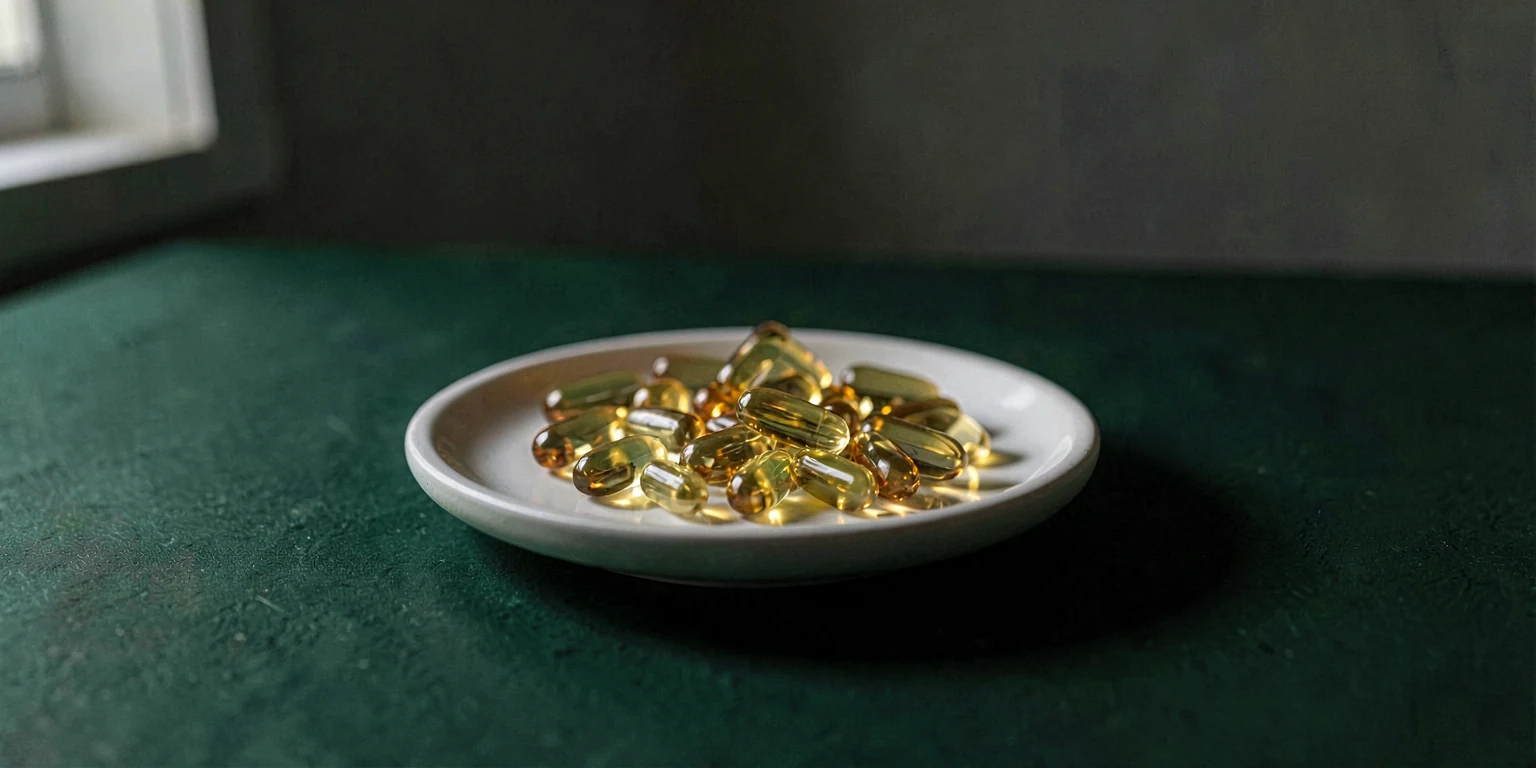
Small, real, and only from the right kind of capsule. Fish oil moved depression scores down by a modest margin across 26 trials in adults.1 All of the benefit came from products built mostly on EPA, one of the two main fats in fish oil. The ones built on the other, DHA, did nothing.1
What the trials measured
Nearly every trial here does the same thing. Give people fish oil capsules or a dummy for two to four months. Score their symptoms on a depression questionnaire at both ends. Compare the groups.
The results arrive in a unit that needs explaining. A standardized difference states the gap between the two groups in terms of how widely people's scores varied to begin with. On that ruler, -0.236 counts as small and -0.545 as medium.4 What the unit does not tell you is how many points on a questionnaire moved, or whether anyone would notice the difference in a person.
The largest look at adults put the overall figure at -0.28, which is at the small end.1 A later analysis of the trials that could be sorted by their formula landed in the same territory, at -0.36 for EPA-rich products, with a plausible range of -0.68 to -0.05.2 The individual trials disagreed with each other a great deal, which is worth holding on to before believing any single headline.
EPA is where the signal is
Fish oil is a blend of two fats, EPA and DHA, and the ratio seemed to matter more than the total. Products that were pure EPA, or at least 60% EPA, helped. Products dominated by DHA did not.1 A second, independent analysis drew its line in the same place, at 60% EPA.2
That has a consequence at the shelf. The big number on the front of a fish oil bottle is total oil. The EPA share is in the small type on the back, and in many products it is a fraction of the total. Two bottles with the same front label can sit on opposite sides of the 60% line.1
The depression trials show a window rather than a slope: too little does nothing, a middle range works, and more than that stops helping. One analysis found the benefit at a gram of EPA a day or less.1 The other found it between one and two grams a day, at -0.43 (range -0.79 to -0.07).2 At two grams and above the effect faded to -0.20 (range -0.48 to 0.07) and stopped being distinguishable from chance.2
Who the effect applied to
The averages hide a split between people who are actually depressed and people who are not.
The clearest case is the trials in pregnancy and after birth. Overall the effect was -0.236 (range -0.463 to -0.009), at the small end.4 In women who were depressed at the start it was -0.545, medium-sized, against almost nothing in women who were not.4 The range for depressed women, -1.182 to 0.093, still reached past zero, so treat the split as a hint.4
Timing mattered as much as diagnosis. During pregnancy the effect was -0.071, which is nothing at all. After birth it was -0.656.4 Those two numbers come from the same supplement inside the same analysis.
In young people the picture thins out. Five trials in children and adolescents with diagnosed depression produced -0.34 (range -0.85 to 0.17), with certainty rated very low.5 Remission ran at 50% on omega-3 against 48% on placebo, which is the same thing twice.5
Three ways to get this wrong
The first is to add it to a treatment that already works and expect more. Four trials put fish oil on top of continuing sertraline for two to three months and found no extra improvement. The difference on the depression score was 0.50, pointing the wrong way, and nowhere near reliable.6
The second is to take the published average at face value. The formula-sorted analysis found the fingerprint of publication bias: small trials that show a benefit reach print more often than small trials that show nothing, so the average is probably flattering.2 A survey of the existing analyses rated the evidence for supplements in depression and anxiety weak. The one suggestive finding it did report was for eating fish, where a higher intake went with 0.78 times the risk of depression.3
The third runs the other way: treating a small, uneven effect as no effect. The EPA threshold has now turned up in more than one independent analysis, at the same 60% line.1,2 Dismissing it takes as much selective reading as inflating it.
Anxiety runs the other way
Anxiety was examined separately, with attention to dose. Each extra gram a day of omega-3 went with a moderate drop in anxiety scores, -0.70. The largest improvement sat at two grams a day, and doses below two grams did not move anxiety at all.7
That is the part that should stop anyone from picking a dose off a shelf. There are two curves here and they point in opposite directions. Two grams a day is where the depression benefit disappears2 and where the anxiety benefit peaks.7 Certainty on the anxiety side was rated very low.7 Either curve could be an artifact of small trials, and nobody can yet say which.
What remains unknown
Length is the first gap. These trials ran ten to sixteen weeks, or eight to twelve when fish oil was added to a drug.5,6 Nothing here speaks to what a year of capsules does, in either direction.
Dose is the second. One analysis places the benefit at a gram of EPA a day or less, another between one and two grams, and the anxiety curve peaks at two.1,2,7 Those are three different recommendations from the same shelf of evidence.
Mechanism is the third. The proposed explanation is anti-inflammatory, and the largest analysis closed by asking for trials that select people by inflammation and by the severity of their depression, because the trials so far were not built to test it.1
What survives all that is a small effect, in people who are genuinely depressed, from products that are mostly EPA, which the published record probably overstates.
QUESTIONS THIS POST ANSWERS
- Does it matter whether a fish oil supplement is mostly EPA or DHA for mood?
- Yes, and it is the clearest finding in the literature. In the 26-trial meta-analysis, products that were pure EPA or at least 60% EPA showed benefit on depression scores, while DHA-pure and DHA-dominant products showed none. A separate meta-analysis of ten trials drew the same line at 60% EPA, with an effect of -0.36 on the standard scale.
- How long do the mood trials run before an effect is measured?
- Not long. The adolescent trials in the Cochrane review ran 10 to 16 weeks, with a median of 12, and the trials that added omega-3 to sertraline ran eight to 12 weeks. No pooled analysis here says anything about what happens after a few months.
REFERENCES
Each reference was re-checked against PubMed before publication. How sources are checked
- 1Liao Y, et al. Efficacy of omega-3 PUFAs in depression: A meta-analysis. Translational psychiatry. 2019. Source
- 2Kelaiditis CF, et al. Effects of long-chain omega-3 polyunsaturated fatty acids on reducing anxiety and/or depression in adults; A systematic review and meta-analysis of randomised controlled trials. Prostaglandins, leukotrienes, and essential fatty acids. 2023. Source
- 3Gao X, et al. Unsaturated Fatty Acids in Mental Disorders: An Umbrella Review of Meta-Analyses. Advances in nutrition (Bethesda, Md.). 2022. Source
- 4Mocking RJT, et al. Omega-3 Fatty Acid Supplementation for Perinatal Depression: A Meta-Analysis. The Journal of clinical psychiatry. 2020. Source
- 5Campisi SC, et al. Omega-3 fatty acid supplementation for depression in children and adolescents. The Cochrane database of systematic reviews. 2024. Source
- 6Chambergo-Michilot D, et al. Efficacy of omega-3 supplementation on sertraline continuous therapy to reduce depression or anxiety symptoms: A systematic review and meta-analysis. Psychiatry research. 2021. Source
- 7Bafkar N, et al. Efficacy and safety of omega-3 fatty acids supplementation for anxiety symptoms: a systematic review and dose-response meta-analysis of randomized controlled trials. BMC psychiatry. 2024. Source