Light therapy lamps: the brightness, timing and minutes the trials used
Trials that worked used lamps far brighter than a lit room, for a set number of minutes a day. The numbers behind a light box turn out to matter more than the idea of one.
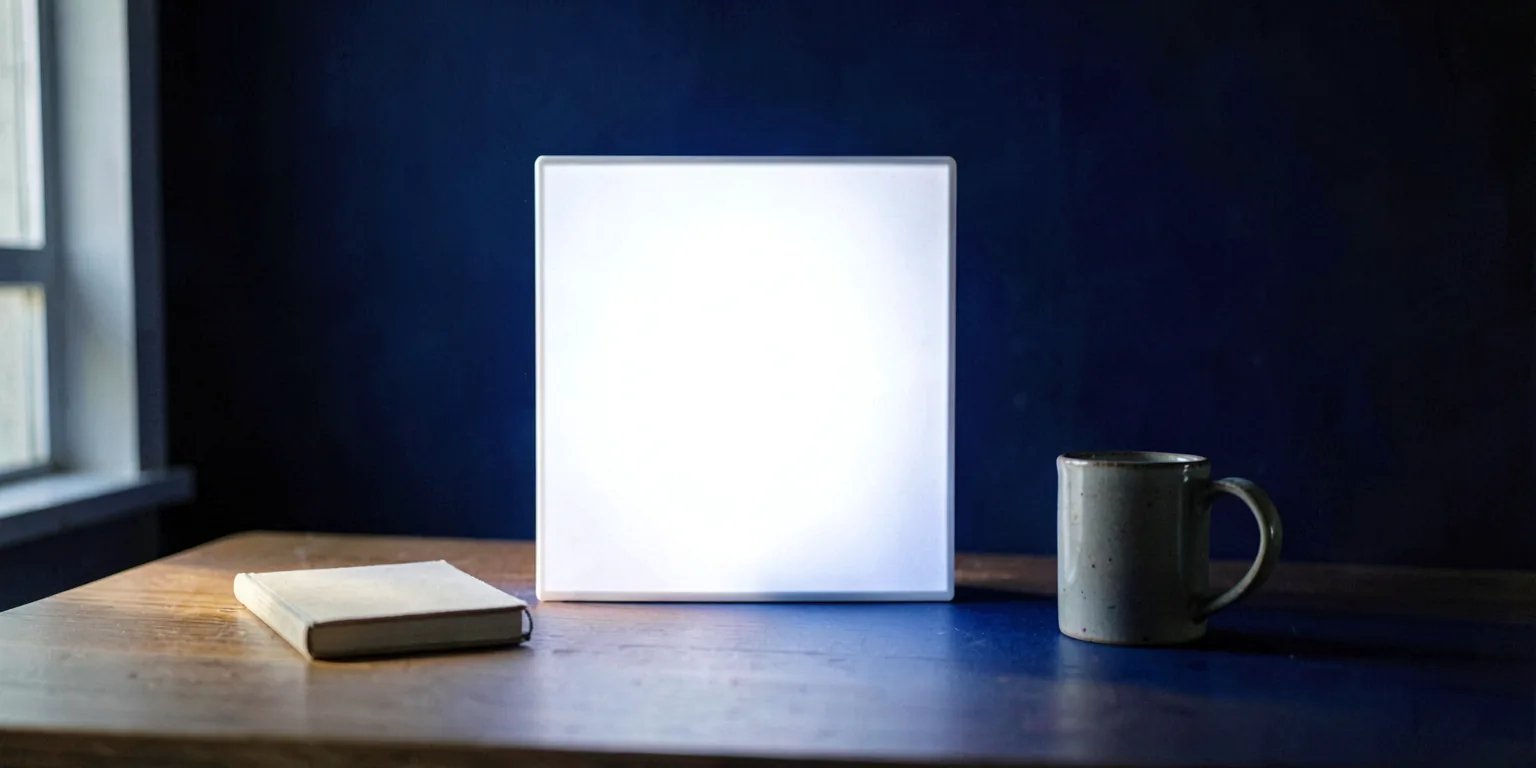
Most trials that worked used a lamp far brighter than a lit room. People sat in front of it for a set number of minutes a day, usually in the morning. The dim placebo light was 400 lux or less. A lamp counted as active at 1,000 lux or more, and some trials required 5,000.2
What the trials measured
The bulk of this evidence comes from people with seasonal affective disorder, a pattern of depression that recurs each winter. A smaller body of trials looked at depression that is not seasonal at all. Both designs put people in front of a light box or a light visor for a set number of minutes a day. Their depression scores are then compared against a group given a dim, inactive light or another placebo. One review pooled 15 such trials in non-seasonal depression, covering 883 patients. It found lower depression scores with bright light than with the control condition.1
How bright the effective lamps actually were
The brightness of the light, not just its presence, defined the comparison in these trials. One review only included trials where the active light measured at least 1,000 lux, set against a placebo of 400 lux or less.2 That is the line between a genuine light box and an ordinary room lamp. Most home and office lighting sits well under 500 lux. A separate review of light added on top of antidepressant medication set its bar even higher. It only counted trials that used at least 5,000 lux, held for at least 30 minutes.3 Ten such trials, covering 458 patients, showed a benefit from adding that light to the medication people were already taking.3
Color turned out not to be a shortcut around brightness. Blue light has been marketed as a gentler, dimmer alternative to a full light box. The review that pooled the blue-light trials found no evidence it beat an inactive light, and no difference from an active one either. It called the benefit unproven.4
Timing and duration mattered as much as the lux number
Brightness alone did not explain who benefited. In one older review of non-seasonal depression, the response to bright light reached statistical significance in the trials that gave the light in the morning. It did not reach significance when every trial was pooled regardless of timing.5 The same review found a bigger effect in its highest-quality studies than in the full pool.5 A newer review of the same question found a pattern worth noting. Trials lasting two weeks or less, and separately trials using 60 minutes or more of daily exposure, tended to show stronger effects than other regimens.1 Morning use and a longer daily sitting both go with better results, and the abstracts do not separate one factor from the other.
The effect held up in seasonal and non-seasonal depression alike
Seasonal affective disorder is where light therapy first earned its reputation. The numbers there are among the largest reported in this literature. One review found an effect size of 0.84 for bright light treatment across eight studies of seasonal depression. It found a separate effect of 0.73 for dawn simulation, across five studies.6 Dawn simulation is a light that brightens gradually before waking, rather than switching on at full strength. The same review found a smaller but still real effect of 0.53 in three studies of non-seasonal depression.6 Bright light added to antidepressant medication in non-seasonal depression came out at -0.01 across five studies, which is no effect.6 That sits uneasily beside the ten-study augmentation finding above, and the two reviews did not pool the same trials.
These are not small numbers as these things go. But each rests on a handful of studies, and a few small trials can move an average a long way.
A lamp is only useful if someone sits in front of it for the required stretch. In the augmentation trials that meant at least 30 minutes at 5,000 lux, about the length of a short television episode.3 That daily commitment, not a passing glance at a bright window, is what these trials tested.
What remains unknown
Trial length is the clearest limit. Many of the studies behind these numbers ran for two weeks or less. The same review found the strongest effects in those short trials.1 That is not necessarily a sign that light therapy works fast, and the abstract does not say why. One side effect also needs a mention: that older review found hypomania, a stretch of unusually high mood and energy, was more common in the bright light group than in the control group.5 Quality varied a great deal within the same pooled analyses. The reviews that separated high-quality trials from the rest found meaningfully different results depending on which studies were counted.5 None of the trials summarized here compared a lamp against actual outdoor daylight. Nothing here settles whether a walk outside in the morning does the same job as a box on a desk. Most of these trials also used a dim light as the comparison, not a control that does nothing at all. The reviews also call for better-defined active and placebo conditions.6 What the evidence does support is narrower and more concrete: a specific brightness, used at a specific time of day, for a specific number of minutes, tested against a dim placebo rather than against nothing at all. That is a useful starting point for choosing a lamp, even if it falls short of a universal prescription.
QUESTIONS THIS POST ANSWERS
- How bright does a light therapy lamp need to be?
- The trials that found a benefit used lamps far brighter than ordinary indoor lighting. One review defined the active light as at least 1,000 lux against a dim placebo of 400 lux or less, and found lower depression scores at the end of treatment with the brighter light. A separate review restricted itself to trials using light of at least 5,000 lux held for at least 30 minutes, when the light was added on top of an antidepressant, and still found a benefit. Both thresholds sit well above typical room lighting, which is usually under 500 lux.
- Does morning sunlight do the same job as a lamp?
- None of these trials tested natural morning sunlight against a lamp, so the abstracts cannot answer that directly. What they do show is that timing toward the morning mattered: an early review found a significant effect in the trials that gave light in the morning, while the same trials pooled across all times of day fell short of significance. That points to morning light being important in general, but it does not stand in for a lamp of known, tested brightness.
REFERENCES
Each reference was re-checked against PubMed before publication. How sources are checked
- 1Tong H, et al. The effect of bright light therapy on major depressive disorder: A systematic review and meta-analysis of randomised controlled trials. Asian journal of psychiatry. 2024. Source
- 2Pjrek E, et al. The Efficacy of Light Therapy in the Treatment of Seasonal Affective Disorder: A Meta-Analysis of Randomized Controlled Trials. Psychotherapy and psychosomatics. 2020. Source
- 3Penders TM, et al. Bright Light Therapy as Augmentation of Pharmacotherapy for Treatment of Depression: A Systematic Review and Meta-Analysis. The primary care companion for CNS disorders. 2016. Source
- 4Do A, et al. Blue-Light Therapy for Seasonal and Non-Seasonal Depression: A Systematic Review and Meta-Analysis of Randomized Controlled Trials. Canadian journal of psychiatry. Revue canadienne de psychiatrie. 2022. Source
- 5Tuunainen A, et al. Light therapy for non-seasonal depression. The Cochrane database of systematic reviews. 2004. Source
- 6Golden RN, et al. The efficacy of light therapy in the treatment of mood disorders: a review and meta-analysis of the evidence. The American journal of psychiatry. 2005. Source