Ashwagandha for stress: the cortisol trials, and who ran them
Cortisol falls and stress scores move a long way. The trials disagree wildly with each other, the certainty is rated low, and the liver injury reports arrived later.
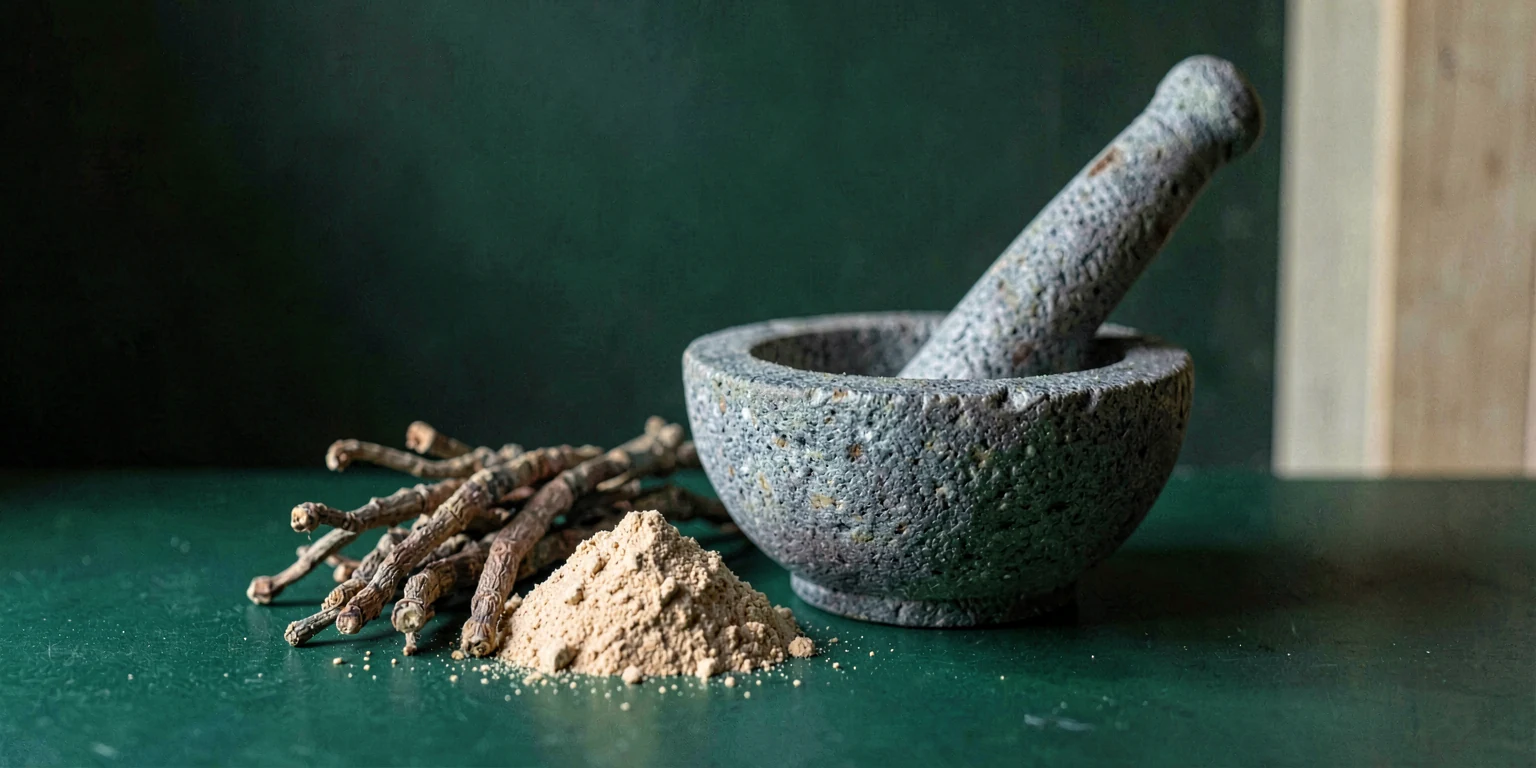
Ashwagandha does lower cortisol, the hormone that rises under stress, and people taking it report feeling calmer.1 The dose behind most of that work is 240 mg a day of a concentrated root extract, taken for about two months.4 The catch is the liver: injury has turned up after a few weeks of use.6
The cortisol result is the solid part
Of everything claimed for adaptogens, this is the claim that has held up best. Collect the trials that measured hormones and the pattern is consistent: cortisol down, serotonin up, thyroid hormones unmoved.1 Testosterone rose in men and stayed flat in women.1
The trial that looked hardest at what was happening gave 60 stressed but otherwise healthy adults either a placebo or 240 mg of a standardized extract, once a day for 60 days.4 Morning cortisol fell further on the extract, and so did DHEA-S, another hormone made by the same glands.4 One of its two stress questionnaires reached statistical significance. The other did not, and it was the one that measured stress rather than anxiety.4
That last detail is the whole tension in miniature. The hormone moves. A hormone is not a feeling, and the distance between the two is where this literature gets complicated.
The symptom effects are too large to believe
Here is the number that should stop a careful reader. One review put the reduction in stress scores at a standardized mean difference of -1.75 against placebo, and anxiety at -1.55.3 A standardized mean difference expresses the change in units of how spread out the scores were to begin with. The usual reading calls 0.8 a large effect, so these sit well beyond it.
A value of 1.75 is not merely large. It is bigger than antidepressants manage in depression, bigger than most talking therapies report, from a root extract taken for a few weeks. Effects that size, in a literature made of small trials, usually say something about the trials rather than about the plant.
The same review hands you the evidence for that reading. Its trials disagreed with each other almost completely, and it graded its own certainty in both results as low.3 Its dose analysis came out incoherent: a favorable effect on anxiety stretching all the way up to 12,000 mg a day, but on stress only between 300 and 600 mg a day.3 A supplement whose useful dose spans a fortyfold range does not have a known dose.
The figures from a second review are more modest and easier to believe. Perceived stress came down by 4.72 points on a standard questionnaire, and anxiety by 2.19 points on a clinician-rated one, both with wide ranges around them.2 That is a real change, and it is the kind of change a plant extract might plausibly produce.
Who ran the trials, and how well
The oldest review in this set is the most direct about quality. Every human trial it could find carried an unclear or high risk of bias, and the designs varied so much that it declined to combine them at all.5
Its summaries of the individual results show why that matters. In one trial, anxiety scores fell 56.5% among people taking ashwagandha, against 30.5% among people receiving psychotherapy.5 Mental health research does not routinely produce a herbal extract that beats therapy by that margin, and results of that size rarely survive a second attempt.
The abstracts do not say who paid for the work, so that cannot be read off them. What can be read off them is the shape of the trial base. The trial that measured hormones tested a named proprietary extract at one fixed dose.4 That is the pattern here. What gets tested is a specific branded preparation, and what gets repeated afterward is a claim about a plant.
The safety signal arrived later
A trial of 60 people running 60 days cannot detect a harm that is rare. The trial above reported that every participant finished with no adverse events, which is what a study that size should be expected to report whether or not a rare harm exists.4
The harm surfaced in liver clinics instead. A case series from Iceland and a US liver injury network described patients who turned jaundiced after taking ashwagandha-containing supplements, in some cases for as little as 2 weeks and in others up to 12.6 Itching and high bilirubin dragged on for 5 to 20 weeks, and liver tests came back to normal within 1 to 5 months in most of them.6
A later review collected the published cases. Most people recovered once they stopped taking it.7 Not everyone did. One person's liver failed and needed a transplant, and three patients who already had cirrhosis died after their liver function collapsed.7 The reviewers' one firm recommendation is that people with advanced liver disease should be told to avoid the herb.7
Two things are true at once, and both matter. These are scattered reports with no denominator, so nobody can calculate a rate, and the rate is probably low. And the injury repeats itself with the same shape each time: weeks of use, then jaundice, then slow recovery. That is more consistency than the dose-response curve managed.
What is still unknown
How often the liver injury happens. Case reports count events, not the number of people exposed, so no risk per user can be worked out from them.
Whether the drop in cortisol is why anyone feels better. Trials measured the hormone and the mood, and never tested whether one explains the other.
Whether the symptom effects are real at their stated size. Graded low certainty, assembled from trials that contradict one another, the headline anxiety figure is a summary of that disagreement rather than a measurement.3
What a dose is. The only dose analysis available runs from 300 mg to 12,000 mg a day depending on which outcome you look at.3
And what happens past two months. One review closed by saying more information is needed on safety with long-term use, which is a fair description of where the whole question sits.2
QUESTIONS THIS POST ANSWERS
- How long does ashwagandha take to have an effect in the trials?
- The trials do not really answer this, because most of them measured once at the end. The randomized trial that tracked hormones gave 240 mg of a standardized extract once daily and assessed outcomes over 60 days, so the effect it reports is a two-month effect. No study here compares week two with week eight.
- Is ashwagandha reasonable to take every day for months?
- The efficacy trials cannot say, because they were built to run about 60 days and one meta-analysis explicitly noted that more information is needed on long-term safety. What exists beyond that window is case reports: liver injury developing after a latency of 2 to 12 weeks, and severe outcomes including one liver failure requiring transplantation and three deaths in patients who already had cirrhosis.
REFERENCES
- 1Fornalik M, et al. Hormonal Modulation with Withania somnifera: Systematic Review and Meta-Analysis of Randomized-controlled Trials. Planta medica. 2026. Source
- 2Arumugam V, et al. Effects of Ashwagandha (Withania Somnifera) on stress and anxiety: A systematic review and meta-analysis. Explore (New York, N.Y.). 2024. Source
- 3Akhgarjand C, et al. Does Ashwagandha supplementation have a beneficial effect on the management of anxiety and stress? A systematic review and meta-analysis of randomized controlled trials. Phytotherapy research : PTR. 2022. Source
- 4Lopresti AL, et al. An investigation into the stress-relieving and pharmacological actions of an ashwagandha (Withania somnifera) extract: A randomized, double-blind, placebo-controlled study. Medicine. 2019. Source
- 5Pratte MA, et al. An alternative treatment for anxiety: a systematic review of human trial results reported for the Ayurvedic herb ashwagandha (Withania somnifera). Journal of alternative and complementary medicine (New York, N.Y.). 2014. Source
- 6Björnsson HK, et al. Ashwagandha-induced liver injury: A case series from Iceland and the US Drug-Induced Liver Injury Network. Liver international : official journal of the International Association for the Study of the Liver. 2020. Source
- 7McIntyre D, et al. Ashwagandha (Withania somnifera)-Associated Liver Injury: A Scoping Review of Clinical Characteristics and Safety Considerations. Cureus. 2026. Source